
New flood research finds Derbyshire town 'distrusts authorities' ahead of showdown over 400 homes development plan


A new report by climate resilience researchers has urged authorities to do more to protect Matlock from the threat of flooding, just as the town prepares for a final showdown over plans for hundreds of new houses on hillside fields.
In the hope of learning lessons to apply elsewhere in the UK, social scientists Ruth Mckie and Adam Aitken, from De Montford and Salford universities respectively, carried out field research in Matlock to understand how members of the community are trying to make the town more resilient to increasingly frequent and severe flooding.
They spoke to key people in the local flood management system, and interviewed dozens of residents and business owners whose properties are known to be at risk, to gauge how the town might better withstand, respond, adapt, and bounce back in the face of an ever-present danger.
Their findings were published in the International Journal of Disaster Risk Reduction this month, and warn of a “disconnect between community members and formal institutions (i.e. government organisations) that left participants disheartened and frustrated.”
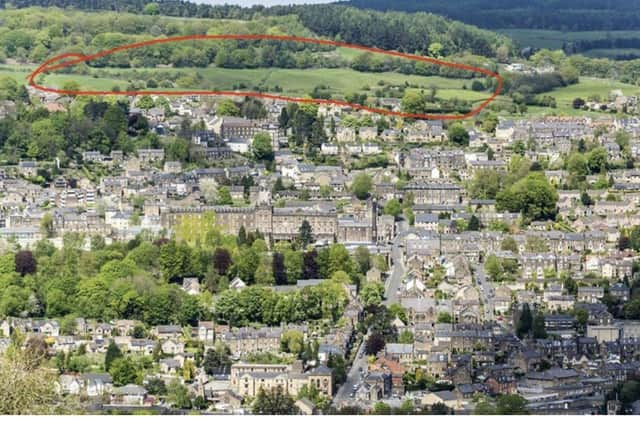
It may prove a timely intervention or a cry for action that will quickly be washed away, given the inquiry by the national Planning Inspectorate, beginning on March 11, into Derbyshire Dales District Council’s (DDDC) refusal of plans for around 400 new homes on the greenfield Wolds area off Gritstone Road.
Explaining one of their reasons for studying Matlock, the paper’s authors write: “Housing developments above the town centre in recent years appear to have coincided with increases in flooding events, this provided an opportunity to explore how government and local authority sustainable development policies may be undermining opportunities for developing effective community resilience to flooding.”
Belief that the Wolds development will significantly increase the risk downhill has been a key argument for those residents who have been find the proposals for more than a decade, and there has been much dispute about assessments which fed into the district council’s decision making.
In January DDDC announced it would not seek to defend its decision at the inquiry and would instead aim to impose certain conditions on the developer – such as flood mitigation measures – if the inspector grants permission for the plans.

That announcement followed a council meeting from which the public were largely excluded, and was described as an “abject betrayal” by former Dales MP Sarah Dines – starkly illustrating a rupture between residents, their elected representatives and other institutions as described in the new report.
The authors found plenty of reasons to commend the people of Matlock, noting evidence of strong community solidarity in times of crisis and networks with a longer-term focus on adaptation.
They highlight one example of a resident who takes it upon himself to regularly unblock drains in the area, and others who have privately developed extensive evidence about the state of the town’s man-made and natural flood defences, the ecosystems around them and how those might be strengthened in future.
But the authors also found that kind of local knowledge and volunteer expertise did not always tally with institutional approaches to protecting the town, such as when businesses were told to halt trading in preparation for floods which never arrived, and a feeling that the various agencies tend to point fingers at one another without addressing persistent problems.
The Wolds case is singled out to illustrate how the institutions’ handling of the planning application – given initial approval by a previous DDDC administration – had fostered distrust in the community.
The authors write: “Participants felt the pursuit of financial gain by local authorities through proposed housing developments was not in the interests of the community and undermined successful community resilience building especially if flood mitigation was not appropriately implemented.
“If these conflicts and differences are not ameliorated, community resilience building will be stalled particularly when outside stakeholders – often with greater power – fail to account for all community voices.”
They also cite one local interviewee who told them: “It’s not a case of whether the flood defences are good enough, it’s that the town has grown so much that the drains can’t cope.
“If you think about that, its outrageous really, the council has made so much money off selling that land and getting all these planning applications approved, and they’ve got so much more Council Tax coming from all these people that are going to live here, but then businesses that are suffering because of it. It’s just suffer, suffer and suffer. I would really like someone to take accountability for it.”
Another said: “How loud do we have to shout before someone listens and takes notice and takes responsibility for their own for their own judgment in what they provide for the community? It’s wrong.”
In their conclusions the authors suggest ways to heal the fractured relationship between community and government/local authorities and rebuild trust.
Their ideas include funding for community-led proposals on ‘nature-based solutions’ to flood defence, regular and improved communication between local councillors, officers and residents, and a greater recognition of local knowledge and experiences of the community.
Even if that advice sinks in over time, it may have little effect on the outcome of the Wolds case, which will be decided at a time when the Government is pressuring councils to rapidly increase housebuilding.
But forresident Steve Martin, a professor in the field of environmental sustainability, it should be a wake-up call to all involved.
He said: “This comes from credible social scientists and is funded by the British Academy. It strengthens the case for refusal and refutes the recent claims made by Sir Keir Starmer and Secretary of State Angela Rayner that people like me and many others are the “NIMBYs” and “blockers” of further housing developments in this country.
“We fully support more social and affordable housing in areas which are not subject to frequent and climate enhanced flooding and risk to life.”
Derbyshire Dales District Council has been unwilling to answer questions from the Derbyshire Times in advance of the inquiry, and declined to comment on the contents of the new report.
Speaking for Derbyshire County Council as the lead local flood authority, Councillor Charlotte Cupit said: “We always want to work on behalf of, and with, residents and communities in reducing flood risk, especially as we face the challenges of climate change and the increasing extreme weather events this brings.
“We’ll certainly take on board the conclusions from the study and will continue to work with other organisations and authorities, such as the Environment Agency and water companies such as Severn Trent Water, who also have responsibilities around flooding, to continue to support all those sadly impacted by flooding.”
She added: “In terms of Matlock specifically, given the flooding incidents over recent years, we continue to work hard with the local flood wardens and other local organisations to ensure that warning, informing and the response to flooding events are as effective as they can be for local residents and businesses. We’ve also adopted new measures to help such as reactive pumps during predicted heavy rainfall.”
The research has also been shared with the Dales’ Labour MP John Whitby in the hope he would support residents and share it with colleagues on the environmental audit committee in parliament – chaired by Chesterfield MP Toby Perkins, who also represents a local constituency learning to live with climate threats.
Mr Whitby said: “The paper highlights the remarkable, collaborative, work the residents of Matlock are doing in protecting themselves, and the town, from flooding. I am pleased that their determination and resilience has now been recognised.
“The concerns of local residents have been repeatedly ignored by some stakeholders and authorities. I have taken a different approach: listening directly to residents through regular surgeries, campaign meetings, and local events.”
He added: “I am strongly opposed to the proposed development on the Wolds. This development, if approved, would disrupt natural drainage systems and place additional pressure on an already overstretched sewage system. Matlock has experienced frequent flooding in recent years and climate change will only make this worse. It is, therefore, clear that this development should not go ahead.
“In November last year, I wrote to the Planning Inspectorate highlighting a number of issues with the appeal process. My formal representation opposing the development was submitted shortly after. Following my intervention, the appeal was delayed by a month, allowing more time for local residents to prepare their case.
“I have written to Severn Trent Water and the Environment Agency to share my concerns with them. I hope they will get back to me with further information that might be of use in the inquiry.”
“As made clear by the paper, it is also important that local voices are amplified and heard. I will, therefore, be writing to over 4,000 local residents, asking them to share their views on the proposed development and I encourage all residents to take part in the survey.
“I remain committed to working alongside residents in a joint effort to protect Matlock and I will keep working hard until the town is free from the risk of flooding.”
Due to the location of the Wolds site in a designated Flood Zone 1, the Environment Agency insists the planning application does not fall within it statutory scope.
However, David Turnbull, area flood and coastal risk manager for the agency, said: “We know the devastating impact that flooding can have, which is why protecting people and communities is our top priority.
“We are already seeing the impacts of climate change and as flooding is predicted to become more extreme and more severe, we urge communities to know and understand their flood risk so they can be resilient to the risk they face.”
He added: “Matlock has existing flood defence assets, which have protected the community from river flooding on many occasions. During 2022-2023 we completed a £12million pound repair of a section of third-party owned flood wall which is now complete and continues to provide protection to the town. We held numerous community drop-in events to help keep the community informed of the work, and set-up a dedicated citizen space webpage to provide further updates.
“Unfortunately, the town has suffered from surface water flooding on recent occasions, and we continue to work with the lead local flood authority, who manage the risk from surface water.”
Severn Trent Water had not responded to a request for comment at the time of writing.
To read the research paper in full, go to sciencedirect.com/science/article/pii/S2212420925000901.