
Forgotten story uncovered of Derbyshire choir star who tragically died after sacrificing musical career to fight in the First World War
The forgotten story of a Derbyshire soldier who sacrificed his promising musical career to fight in the First World War has been revealed nearly a century after his tragic death.
The forgotten story of a Derbyshire choir star who tragically died in the First World War - after giving up his musical career to enlist alongside his brothers - has been uncovered.
Historian, broadcaster and author, David Olusoga OBE, has uncovered the remarkable story of First World War soldier Frank Reginald Froggatt - whose name appears on a war memorial in Eyam.
The promising chorister, who became an Exeter Cathedral soloist before giving up his musical career to serve in the First World War, has resurfaced more than a century after his death.
Frank Reginald Froggatt is one of 23 people commemorated on the Eyam War Memorial, but until now, little was known about the man behind the inscription. Research carried out through UK family history website Findmypast's new Military Lives tool revealed the story of a talented musician whose voice took him around the world - before war changed the course of his life.
Born in Eyam in 1888, Froggatt grew up in a family with deep musical roots. His father, grandfather and great-grandfather had all served as choirmasters at the parish church, and Frank followed in their footsteps - taking on the role himself.
Before he was 21, Froggatt became the youngest member of the famous choir of Dr Henry Coward, visiting Canada, New Zealand, Australia and South Africa as part of a world tour. Newspaper reports reveal that among fellow choir members he became affectionately known as “The Cherub”.
After returning to Britain, Froggatt continued building a distinguished musical career. He performed at local concerts and was appointed tenor soloist at Exeter Cathedral, one of the country's most prestigious musical posts.
When war broke out, however, he chose to give up that career and enlist in Exeter in September 1914 - alongside his three brothers. Serving with the 1/4th Battalion, Devonshire Regiment, he rose from Private to Lance Corporal, deployed to India and later Mesopotamia. Here, Froggatt helped run a field library and reading room for fellow soldiers, distributing books throughout the division while serving near the front line.
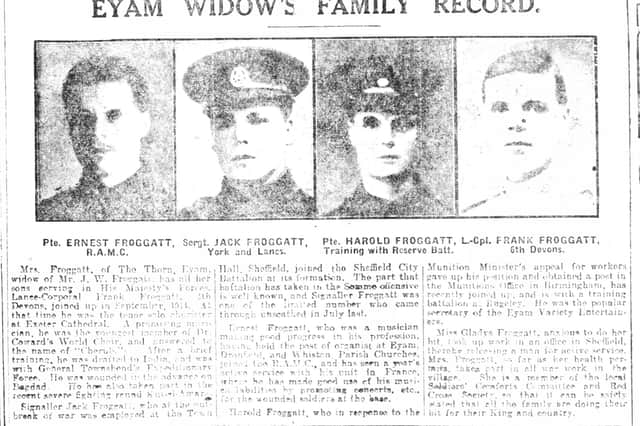

Tragically, on February 3 1917, Froggatt was killed in action in what is now Iraq. Reports sent to his family stated that a sniper shot him while he was observing from a captured Turkish trench. He was buried at Amara War Cemetery. A memorial service was held at Exeter Cathedral, where colleagues remembered him as the first member of the cathedral choir to lose his life in the war.
His story was uncovered ahead of Remembrance thanks to a groundbreaking new digital tool from Findmypast, Military Lives, that connects names on war memorials with millions of historical records and newspaper archives to reveal the people behind the inscriptions.
David Olusoga said: “What struck me about Frank was not only the tragedy of his death, but the richness of the life he lived before the war. By uncovering stories like his, we can begin to see these memorials not simply as monuments to conflict, but as memorials to individuals whose lives helped shape the communities we know today.
“War memorials are among the most familiar historical landmarks in Britain, but for many of us the names engraved on them have become distant and anonymous. Yet every inscription represents a life that extended far beyond military service and a loss that was felt by families, neighbours, workplaces, and entire communities.
“This Remembrance, I’d encourage everyone to visit your local memorial, select one name and go online to discover their story.”
The project marks the first time large-scale machine learning has been used to connect the UK's war memorial data with millions of historical records and newspaper archives.
By linking national memorial records from across the UK with millions of historical records like census returns, military records, and newspapers, the tool enables people to move beyond dates and ranks and discover the real people, families, occupations and communities behind the names.
Uniquely, it also maps the connections between those named on a memorial, revealing previously hidden links between individuals, including family members, neighbours, workmates, and comrades-in-arms.
Jen Baldwin, research specialist at Findmypast, added: “War memorials were never intended to be lists of names alone. They were created to ensure people and stories would not be forgotten. Our research shows that many people are searching for that connection and want to know more about the lives of those that came before them in their local area.
“By using technology to bring together the UK's memorial data, historical records and newspaper archives on Findmypast, we're helping people uncover the human stories within their communities and making remembrance more personal, meaningful and accessible for future generations.”
This Remembrance Day, you can search and remember those who gave their lives in your community for free here: https://www.findmypast.co.uk/discover/world-war-i/memorials