
“I apologise to anyone who was offended' - Derbyshire rector speaks out after Staveley Remembrance Sunday message
Clergyman’s message draws mixed reaction from congregation, with some veterans leaving commemoration service early.
A north Derbyshire clergyman has apologised to members of his congregation who were offended by his sermon on Remembrance Day which referenced the Iraq War and accountability in leadership.
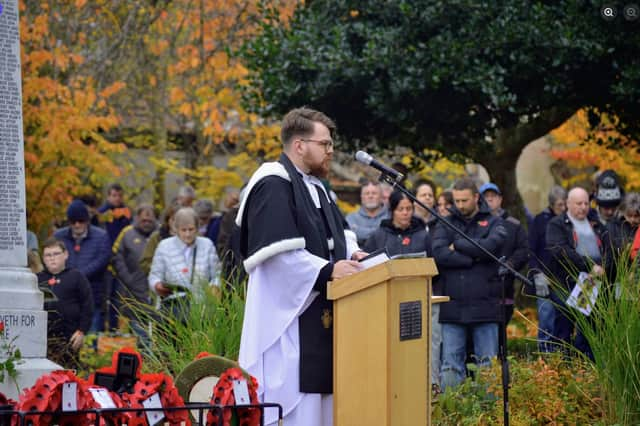

Father Daniel Heaton’s message to the community who gathered for the service in the Remembrance Gardens in Staveley sparked mixed reaction with some veterans leaving early.
A post on social media claimed that that sermon was disrespectful to military personnel that had fought and fallen, other attendees hailed it as powerful and appropriate to the occasion.
Fr Daniel, who is rector of Staveley and Barrow Hill, told the Derbyshire Times: “Leading the town’s Remembrance Sunday service is a privilege. I take very seriously my responsibility in ensuring that those who have made the ultimate sacrifice or suffered lifelong impact from serving in the Armed Forces are respected, remembered and honoured. I also recognise that it is a very emotional time and that many losses in war still are hurtful and damaging for both those who grieve and those who live on. I also know that recent and ongoing conflicts are very raw and painful.
“I acknowldge that some of my congregation had views, both positive and negative, about the sermon and I apologise to anyone who was offended, as that was clearly not my intention.”
Rob Jones was among those who left early. He posted: “I walked out with my family. Absolute disgrace. Attended that service for 10 years. Never again. Pushing a narrative at a remembrance service is truly disrespectful.”
Stu Bradbury called the commemorative service: “The worst one have been to in over 30 years. Veterans walk out midway through it. Politics should not be involved in the remembrance service."
Roger Huckle wrote: “Felt sorry for the veterans who walked away. They came to remember their fallen comrades and were instead subjected to an overlong sermon. I have never seen so many leave early.”
Paul Allcock wrote: “This was my first one as a veteran and I thought it was just me, the sermon put me right off. I was thinking, what on earth is he going on about with the weapons of mass description (sic) etc, that wasn’t the point, I went to remember my great-grandad who is on the monument after losing his life in WW1.”
Jacky Nixon said of the clergyman’s sermon: “He forgot what Remembrance is about...he totally disrespected our miltary that had fought and fallen.”
Father Daniel’s message was defended in several social media posts. Natoya Hamlin commented: “I thought the sermon at the memorial service was excellent and entirely appropriate to the occasion. The Iraq War is a politically charged subject, but mentioning it doesn’t automatically mean taking a shot at one side of the political spectrum. I heard it used as an example of how people and governments can get things wrong, and how serious the consequences can be, especially for service members and those who experience the trauma of war.
“The official Iraq Inquiry later found that the intelligence about weapons of mass destruction had been presented with more certainty than the evidence justified, and the expected stockpiles were not found. This is a fact, not a partisan position. That was relevant to the sermon’s theme: how do we seek truth, and what happens when we fail to do so?
“At a time when many people feel disillusioned with government, I found the vicar’s message a welcome invitation to reflect, not a partisan attack. He brought it back to the Christian heart of the matter: truth is ultimately found in Christ and through the Cross. I thought it was bold, measured and much needed in these times. Our service men and women are sometimes called to fight in wars with weak justification and this gives us a way to work through the trauma that can cause. ”
Tom Oxley commented: “His words about truth, trust and the consequences of war were incredibly powerful, thought-provoking and, at times, rather uncomfortable. Reflecting on the Iraq War and the claims made at the time, he raised some important questions about the decisions that lead nations into conflict, the responsibility of those making those decisions and, ultimately, the human cost.
“It was an exceptionally poignant message. At times, his words were refreshingly frank, perhaps even a little blunt, but I felt that was precisely what made them so powerful. Sometimes the most important messages are those that challenge us, make us uncomfortable and encourage us to think a little more deeply.
“And perhaps, given the times we're living in, it's a message that needs to be heard now more than ever.
“Remembrance isn't simply about looking back at history. It's also about learning from it, questioning the decisions that shape our world and remembering that behind every conflict are real people, families and lives forever changed.”
The Derbyshire Times requested a copy of the rector’s sermon but was told by a spokesperson for the Diocese of Derby: “We don't routinely share sermons after an event.”