
Storm Babet one year on: Chesterfield MP says flooding issues have never been more important - but no quick fixes
A year on from the floods which devastated many Chesterfield families, homes and workplaces, MP Toby Perkins says addressing the risk of repeat incidents has never been more important to him – but also warns there are no quick fixes.
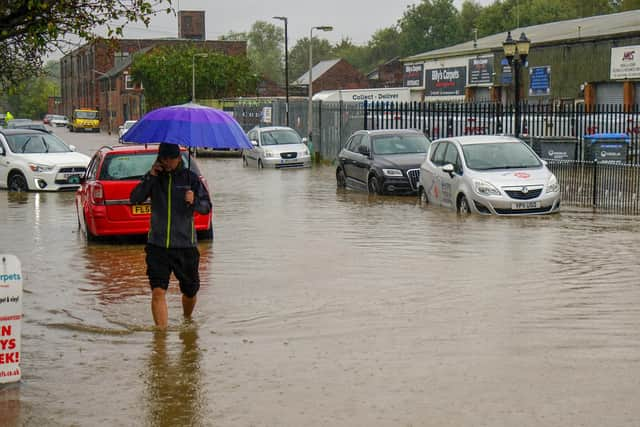
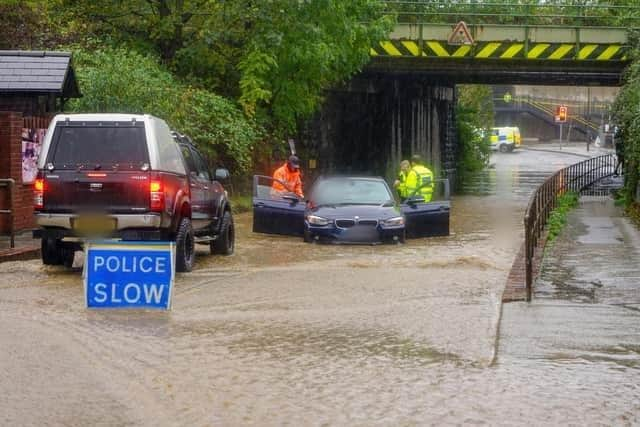
The after effects of Storm Babet in October 2023 are still being felt by residents and employers hit by the floods which washed through around 400 properties flood, and for many others the memories surface with every heavy rainfall.
Reflecting on the impact of the last 12 months, Mr Perkins believes that the constituency can be much better protected against future storms while also acknowledging new realities in the age of climate breakdown.
He said: “If we’re honest, the number one lesson is that when we get the amount of rain we did in 2023, people are going to get flooded. I don’t think there is any scheme that’s been talked about which could cope with that level of water, but there are things we can do to stave off some of it.

“We need to accept we live with climate change and increased risk of extreme weather events, then make sure there are mechanisms in place to warn people and do all we can to keep water courses and flood defences as strong as possible.”
He added: “Obviously I’m desperate for that to happen as quickly as possible. There’s nothing more important to me than preventing the kind of impact I’ve seen floods have on families and businesses. I don’t want anyone to have to go through that again.”
With autumn weather now setting in, progress towards improving those defences and warning systems is hard to gauge.
Derbyshire County Council has yet to complete its investigatory process into Storm Babet and there are no signs of significant work around Chesterfield’s rivers.

Mr Perkins said: “I think we’re in a marginally better position than we were last year. But the truth is we could have flooding at any point.
“It is impossible to say when these so called one-in-75-year events will happen. We had one in 2007 and another in 2023. I can’t say for certain the necessary work will happen before the next one.
“I share the impatience that many residents have. It’s taken the county council a long time to produce their report and many other areas have produced theirs more quickly.
“The major thing that will make a difference is a scheme for the River Hipper, which means upstream water storage at Holymoorside, so if the river level reaches a certain point it would start flowing into that instead.

“It would be similar to the flood basin at Wingerworth, which was a substantial multi-million pound scheme. That worked last week, and in 2023, but it didn’t stop people getting flooded. Obviously it only has a certain capacity and once it’s full the river continues to rise, so we need to go back to the drawing board and see if there’s anything more that can be done there.”
He added: “The Hipper scheme has not previously been top of the list but the river has now flooded twice in 16 years, and I’m pushing once again for the government to recognise that.
“We need central government to work with local authorities and the water boards to investigate it, and I’ve already had a letter from Emma Hardy, the minister for water and flooding to say their in the process of doing a feasibility study for the Hipper scheme.”
Elsewhere, Mr Perkins is also pushing for action to help residents around Tapton Terrace, on the banks of the River Rother, where 83-year-old Maureen Gilbert died in her home during the floods of 2023.
He said: “The Environment Agency have told us it would cost more to protect those houses than they’re worth, effectively arguing it would be better to purchase the houses than build new walls.
“In the DCC report, there is no reference to a compulsory purchase order (CPO), but it does talk about increasing flood water storage, changes at Linacre reservoir and the feasibility of removing a bridge at Crow Lane.
“We need to see whether those are serious alternative plans for the Environment Agency, or whether anyone’s seriously investigated a CPO. I’ve told the minister we need to get on with the conversation about a CPO, or get on with these other proposals.
“Either way we need to better protect people. At the moment people on Tapton Terrace are living at their wits’ end and it’s not fair.” As previously reported, perhaps the biggest question is where the money will come from for any of these projects.
No one has publicly disclosed cost estimates yet but Mr Perkins is clear that the answer will ultimately have to come from Westminster.
The new Labour government’s biggest infrastructure move so far has been a £22billion investment in carbon capture and storage, which may help mitigate climate impacts far in the future but will do little about events already linked to past and present emissions.

At the same time, media reports recently emerged that Treasury officials were calling on ministers to make drastic cuts to spending on capital projects.
So a second question floats into view: how many times should Chesterfield residents expect to be flooded before the recovery costs exceed the expense for any potential solutions?
Mr Perkins said: “I’m not going to get into hypotheticals but I think it’s a valid point. Sometimes there’s a cost to not doing infrastructure. There’s a cost to government and the insurance industry, and the impact on people’s lives is massive.
“We know how substantial the cost of flooding is. If we can implement capital schemes to prevent properties being flooded, that cost is worth pursuing.
“We’re still at the stage of identifying how much things might cost, and how many properties that might save, then we can see the cost-benefit ratio. I’m not in the business of false hope but I am pushing to facilitate the business case as quickly as possible, then I’ll be making the case for doing the work.”
He added: “We do also need to have some humility about man’s ability to protect every house up and down the town. When a tsunami happens in the Pacific, it is beyond any capacity to prevent that through engineering. 2023 was not a tsunami, but it was a very, very substantial amount of water.
“The strength of any river defence is always measured by its weakest point. When the wall collapsed on Hipper Street, the Rother raced up Alma Street and flooded Chatsworth Road. As a response to that, the government built a much stronger flood wall, but eventually that meant the street flooded at the opposite end.
“After 2007, millions were spent to protect houses on the Rother. Anything you do to protect one row of houses might mean that some others flood 500 yards down the river. That’s another part of the financial assessment that has to be made.
“I don’t want to be fatalistic but I also don’t want to give false hope. I’m relentlessly pursuing these schemes, but I also think preparedness in the event of flooding is a big part of the equation.”
In many online discussion of Chesterfield’s flooding issues, two ideas that bubble up again and again are dredging the rivers and rethinking the location and types of new construction developments.
Despite the popularity of those arguments, Mr Perkins posits them as factors in a complex wider picture rather than obvious but ignored ways to solve the problem.
He said: “As I understand it, if you were going to dredge one section of the river, water and silt will quickly find the lowest point and it will refill quickly unless you’ve dredged the rest of the river. Things that might be stuck in one section will just get stuck in another one.
“It is in the DCC report that the Environment Agency is investigating an updated dredging assessment on the Rother near Tapton Terrace, and I’m keen for that to happen.
“With how quickly that area can floods, there is a higher risk to life, and I’m very, very keen for anything that can help address that.”
He added: “In terms of planning regulations, I understand those concerns and I think it’s crucial that any new legislation is written in such a way that areas crucial to protect us from flooding don’t get built on.
“Those are totally legitimate concerns but simply not building houses is not the answer. The answer is to take flooding into consideration and balance the risk and reward in each case.
“This government is committed to brownfield-first development, and all around town there are brownfield sites that have not been touched.”
Whatever the weather has in store for north Derbyshire over the coming months, the heightened risks will be a matter for politicians to reckon with for generations to come.
Over two decades in elected office, first as a councillor and now as MP, Mr Perkins has seen the issue climb to the top of his to-do list, mirroring the trajectory of so many global temperature charts.
He said: “There is no bigger priority for me. I’ve recently been made chair of the Environmental Audit Committee in the Commons, and I want flooding to be considered as part of the work that committee does.
“I set up the local flood victims appeal in 2007 and I’ve been involved again this year. As a result I’ve met lots and lots of victims. The impact is massive, and will stay with them for a lifetime. There is nothing more important than to make sure we’re doing all we can to protect people.”