
Why Derbyshire drivers wait nine days for car parts and how major retailers are fixing it
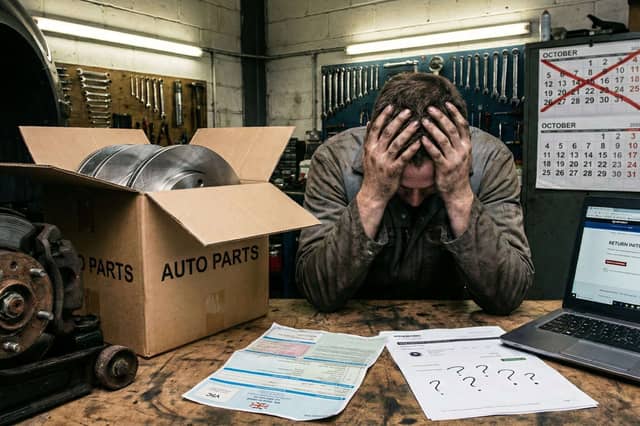

It is Monday, 6:45 am. James Parker from Matlock turns the key in his Ford Focus ignition and hears only a click. The battery is dead. The temperature outside reads −3°C, a typical December morning in the Peak District.
James needs to drive his wife to work in Chesterfield, collect his daughter from school in the afternoon, and take his son to football training in Derby in the evening. Public transport from their village runs twice a day. A taxi to Chesterfield and back costs £60.
At 7:15, James finds a suitable Bosch battery for £76 with free delivery on a small online site. The website promises: "Delivery in 3–5 working days". I’ll be back on the road by Thursday, he thinks. Thursday arrives, and the tracking shows "Customs delay". Friday, the same message. The weekend passes in crisis mode: His wife catches a lift with a neighbour, their daughter stays with grandma, and his son misses training. On Tuesday, nine days later, the battery finally arrives.
The tally: £180 for taxis, two missed working days for his wife (minus £200 in wages), and missed training sessions for his son. Total damage: £456 plus family stress, all because of "fast delivery".
James’s story is typical for small online shops with a single central warehouse located somewhere in Eastern Europe. According to the Society of Motor Manufacturers and Traders (SMMT), over 40% of British garages have reported delays in receiving parts, with average waiting times of three weeks or more for specific components. But can such delays be avoided? What happens to your order between purchase and delivery, and how are major market players solving this problem?
The invisible border barrier
Since Brexit, every parcel arriving from the continent must go through customs clearance. McKinsey research has shown that customs procedures have increased delivery times by an average of 30%.
Sarah Laouadi, Policy Manager for European Road Freight at Logistics UK, comments: "Our industry has done tremendous work preparing for new border and customs arrangements with the EU. But the introduction of new import checks could significantly impact the ability of British businesses to trade effectively."
For buyers, this means that a parcel from Germany or Belgium could be held in customs at Dover for between one and three days. Each step – declaration, inspection and duty payments – adds time. Although your parcel is physically on British soil, it cannot yet be legally handed to the courier.
Empty shelves and the unpredictable last mile
Popular items such as oil filters, brake pads and batteries run out faster than they can be replenished, especially in winter. Rare or model-specific components must be ordered directly from manufacturers, adding an extra five to ten days.
Alexandru Lazariuc, a technical specialist with twelve years’ experience in the automotive industry, candidly admits: "Delivery problems haven’t gone away. Timelines are still unpredictable, courier service quality varies from region to region, goods get lost or damaged. The last mile still depends on local carriers."
In rural Derbyshire, a single courier delivers over 150 parcels a day along narrow roads. Depending on where you are on the route, your parcel could be the first or the last to be delivered; that's a whole day’s difference.
Warehouses closer to customers change the game
Recognising these challenges, leading European auto parts retailers are investing millions in solving logistics problems by strategically placing warehouses close to end markets. AUTODOC, one of the largest suppliers, operates four warehouse complexes in Berlin, Szczecin, Cheb and Ghent. The newest warehouse in Ghent, Belgium, which opened in 2025, is equipped with modern automated equipment for rapid order processing.
The choice of Ghent as the location for the new centre wasn’t random. As Alexandru Lazariuc explains: "AUTODOC’s new warehouse in Ghent isn’t just warehouse number four on the map. We placed it right next to major ports to counteract the volatility of theWestern European supply chain. When the supply chain gets tight, proximity to ports is the only thing that can resolve the situation."
Ghent is just 15 kilometres from the Port of Zeebrugge, a key hub for cargo heading to the UK. The journey of a parcel to Derbyshire: warehouse → 60km to port → ferry across the Channel (4–5 hours) → customs → British courier. The total distance is about 500 kilometres, half the distance from Berlin or warehouses in Eastern Europe.
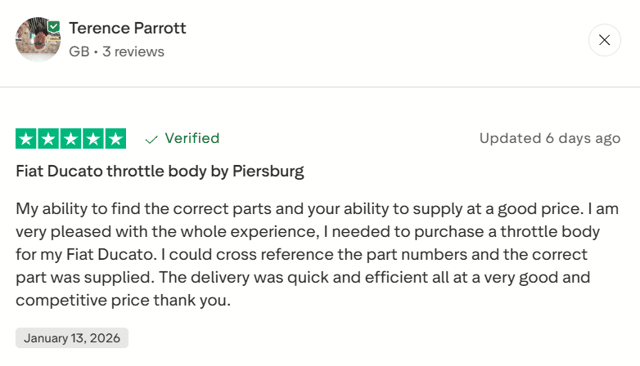
The strategy works in practice. Terence Parrott, who recently ordered a Piersburg throttle body for his Fiat Ducato, shared his positive experience: "My ability to find the correct parts and your ability to supply at a good price. I am very pleased with the whole experience. I needed to purchase a throttle body for my Fiat Ducato. I could cross-reference the part numbers, and the correct part was supplied. The delivery was quick and efficient, all at a very good and competitive price."
For Derbyshire residents, where the UK’s largest Toyota plant is based in Burnaston, quick access to parts is critically important for both personal vehicles and local garages servicing thousands of cars daily.
Five ways to speed up parts delivery
1. Order before a critical breakdown Planning is cheaper than emergency repairs without a car.
2. Check stock status "In stock" means 2–5 days. "On order" means at least a week.
3. Look at the warehouse location Western Europe (Belgium, the Netherlands) is closer to the UK than Eastern Europe.
4. Use tracking actively If a parcel is "stuck" for 3+ days, contact the supplier.
5. Allow extra time in winter From November to March, add two to three days to promised timescales.
Auto parts logistics continue to improve, with more warehouses, modern equipment and transparent tracking. In Derbyshire, where one in three families has a connection to the automotive industry via the Toyota plant in Burnaston, understanding the supply chain is a practical necessity. James’s story shows: "fast delivery" doesn't always mean fast, and cost savings can turn into expensive consequences. Major retailers with distributed warehouse networks help minimise these risks. Now you know what happens behind the scenes and how to avoid surprises.
Tip for readers: When ordering parts through AUTODOC before the end of March 2026, use promo code ATDKRS9 to save an additional 5%.