
"I agree it's a monstrosity": Derbyshire MP asks Government to reassess permission for controversial billboard
After Matlock residents reacted uneasily to the town’s new digital billboard, Derbyshire Dales MP John Whitby has asked a Government minister to reassess the decision to grant planning permission after it was refused by the local authority.
As previously reported, there has been a largely negative response to the 18-square metre board which was erected earlier this month at the busy junction of Bakewell Road and Dimple Road, with permission to remain there for five years.
In a town which draws much of its charm from heritage architecture and a surrounding green hillsides, there is a palpable feeling that the giant illuminated screen – owned by Wildstone, an international business with London headquarters – is entirely alien and unwanted.
Both the town and district councils objected to the planning application last autumn, only to see it approved on appeal by the national Planning Inspectorate.
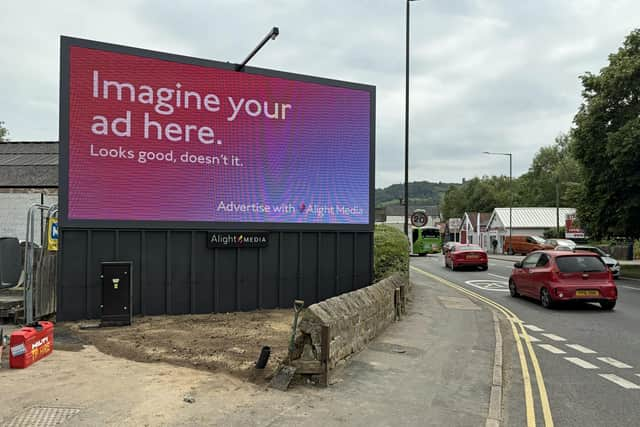

The inspector concluded the site’s immediate vicinity, sandwiched between car parks and relatively modern non-residential buildings, already contained other sizeable advertising displays, and the junction was not in a designated conservation area, and therefore the application could not be refused on the grounds of preserving the area’s character.
Now Derbyshire Dales MP John Whitby has responded to constituents’ concerns by taking up the case with Labour colleague Steve Reed, the Secretary of State for Housing, Communities and Local Government.
Mr Whitby said: “A growing number of residents have written to me about the installation of the digital advertisement board.
“Residents have described the billboard as a ‘monstrosity’ – and I agree with them. The billboard is not in keeping with the surrounding rural landscape, or the historic Victorian spa town of Matlock. In my opinion, planning consent should never have been granted and the billboard should be removed.”

According to Wildstone’s original planning application, the number of such billboards in the UK has rocketed from 45 to 1,300 over the past decade, while the number of comparable traditional ‘poster and paste’ boards has more than halved, from 18,519 to 8,910.
For Mr Whitby, that raises questions over whether the spread is outpacing planning legislation and guidance which could give authorities more control over the boards’ locations.
He said: “I am deeply concerned about whether the Planning Inspectorate's advertisement consent framework adequately accounts for the character of historic market and spa towns that fall outside formal conservation area designation, and what guidance there is regarding digital billboards in towns where visual character is significant but unprotected by conservation area status.
“I am also looking for the opportunity to raise, in Parliament, the matter of whether the current framework is fit for purpose given the rapid and well-funded rollout of digital outdoor advertising by large investment-backed operators.

“As a proud Member of Parliament for the rural and beautiful constituency of Derbyshire Dales, I will do all I can to support residents on this matter.”
Philip Allard, chief operating officer of Wildstone, has previously said: “At Wildstone, we carefully select locations that offer genuine value to advertisers while fitting well within the surrounding area.
“Our screens use technology that automatically adjusts brightness to levels appropriate for the ambient conditions, and 24-hour remote monitoring means the display can be managed at any time. The screen at this site will be operated in full accordance with the conditions of the express consent it received.”