
Derbyshire town reacts to huge digital billboard after council refusal overruled
Matlock residents have been adjusting their eyes to a glaring new addition to the town centre this week – a giant digital billboard first refused by council planning officers then overruled at national level.
Many were blindsided by the sudden appearance of the 18 square-metre ‘D-poster’ at the prominent corner of Dimple Road and Bakewell Road – the western gateway to the town centre – and then not so dazzled when it was switched on a few days later.
Local social media groups have lit up like Las Vegas in reaction to this new rival to Matlock Bath’s Illuminations, including many AI-generated images imagining it as the first sign of Matlock’s metropolis era, or turning it into a meme to advertise their own local businesses.
The consensus seems to be that the billboard is out of keeping with a small Victorian spa town, and that was also the view put forward by local representatives when Derbyshire Dales District Council (DDDC) refused a planning application in October from international business Wildstone – which leases its ‘outdoor media infrastructure’ to advertising operators.
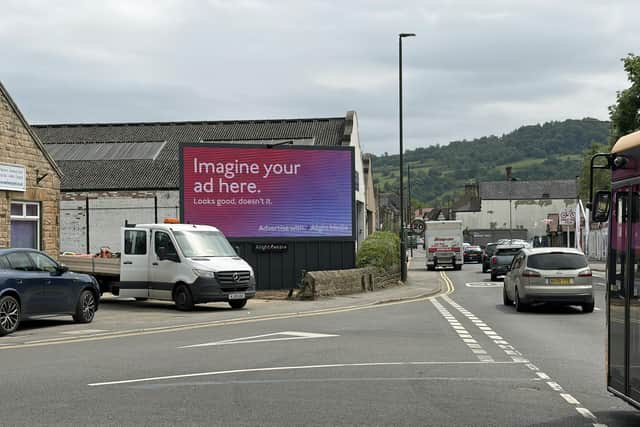

A submission from Matlock Town Council’s planning committee stated: “This application is thought to be of an unsightly and disproportionate size and location.
“The committee feels it is a distraction to road users and it’s not in keeping with the character of the town centre.”
In their refusal, DDDC officers agreed, writing: “Due to its siting, scale and form, the advertisement would appear unduly prominent within the street scene and would be uncharacteristic for the area causing an adverse impact on the visual amenity of its surroundings.
“The application references a range of material benefits to schemes of this nature such as the reduced waste and vehicle trips associated with the upkeep of paper adverts and the flexibility and opportunities to display other messages during void periods. However, it is not considered that these benefits would outweigh the harm to visual amenity in this case.
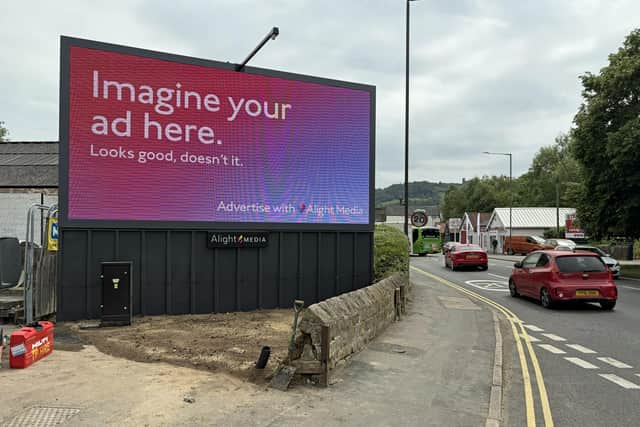
“The local planning authority considered the merits of the submitted application and judged that there was no prospect of resolving the fundamental planning problems with it through negotiation.”
Instead, Wildstone appealed to the national Planning Inspectorate, and in March the council’s refusal was overturned, granting permission for the billboard to stand for five years.
The company, which claims to be the largest owner of advertising assets in the country, digital LED billboards are being rolled out in a modernisation drive to replace more familiar ‘poster and paste’ versions, and allow each location to be used for multiple marketing campaigns at a time.
In Matlock’s case, there was no billboard standing in the same exact spot, though there are other large-format displays in the area.
The appeal noted: “There are no residential properties in close proximity to the site; therefore, there would be no direct views of the proposed advertisements from any nearby dwellings.
"The site is not located within a conservation area and does not fall within either designated or non-designated heritage assets.”
Though DDDC’s Local Plan policies aim to ensure “any development is of a high-quality design that respects the character, identity and context of the Derbyshire Dales landscapes [and] to protect, enhance and restore the landscape character of the plan area,” inspector Naomi Teasdale concluded the billboard did not conflict with those.
She wrote: “Having regard to the character of the locality, including the presence of various advertising displays, and existing commercial signage to nearby establishments, the proposed advertisement display would not appear out of keeping in this setting which is one which is an established location for advertisements and signs.
“The proposed advertisement would be internally illuminated, and I note the lack of illuminated advertisements in the immediate surroundings. However, it would not significantly exceed the size and scale of other adverts in the area such as the paper posterboard located outside the Stanley Fearn shop to the southeast.
“It would not be overly dominant in a street scene where a variety of displays are commonplace. It would not therefore unduly stand out from the existing street scene nor impact the visual amenity of the area.”
Having dismissed concerns over the billboard’s visual impact, the inspector also rejected any arguments over road safety.
Derbyshire County Council highways officers had already consented to the billboard, though restated the standard conditions to ensure it will not distract motorists.
Displayed images should be static, not animated, and not change any faster than ten seconds at a time, while a light sensor on the board should automatically adjust its brightness in tune with ambient light, as set out by specifications from the Institute of Lighting Professionals.
A representative for Matlock Town Council said members were likely to reassess the matter at a meeting on Monday, June 15, though it hard to see how the decision might now be challenged. DDDC and DCC declined to make further comment.
Wildstone chief operating officer Philip Allard said: “At Wildstone, we carefully select locations that offer genuine value to advertisers while fitting well within the surrounding area.
"Our screens use technology that automatically adjusts brightness to levels appropriate for the ambient conditions, and 24-hour remote monitoring means the display can be managed at any time. The screen at this site will be operated in full accordance with the conditions of the express consent it received.”