
Derbyshire council moves to bury criticism over cemetery safety works
“It felt like our daughter’s grave had been desecrated.”
After several months of disquiet over hundreds of gravestones judged too unsafe to leave standing, Dronfield Town Council (DTC) is again seeking to lay the matter to rest.
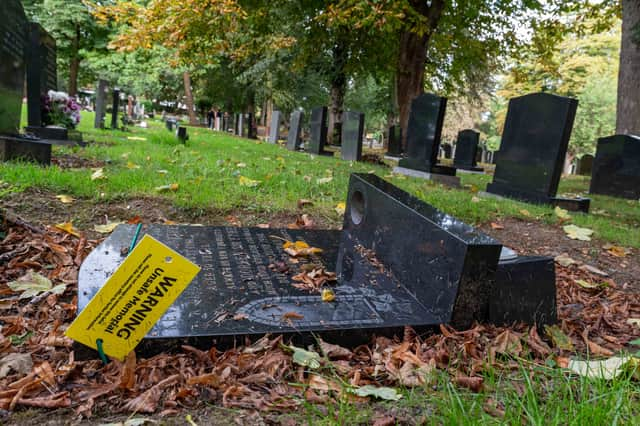
As previously reported, earlier this year headstones and memorials throughout Dronfield Cemetery were tested in line with updates to national safety guidance and, where risks were found, the owners of each plot were asked to arrange repairs within three months or see the stones laid flat.
Similar testing has been carried out in cemeteries across Derbyshire, but in Dronfield the scale of the problem stirred questions over cemetery management, with around 18 per cent of 2,387 memorials deemed unsafe, including some that appeared relatively new and well kept.
Those concerns have rumbled on since and on Wednesday, November 25, partly prompted by enquiries from the Derbyshire Times, DTC published a lengthy rebuttal on its website, describing it as a “final update” in the hope settling the issue once and for all.
In its statements, a spokesperson said: “Burial authorities have legal responsibilities to manage these risks and take reasonable steps to ensure that cemeteries remain safe places for visitors, employees, contractors and volunteers.
“Dronfield Town Council recognises that memorial safety is a sensitive issue for families and local residents.
“The council's approach has sought to balance respect for memorials and the historic character of the cemetery with its legal duty to ensure the safety of visitors, staff and contractors.
“All actions were taken following memorial inspections undertaken in accordance with relevant national guidance and after efforts were made to contact grave owners where contact information was available.”
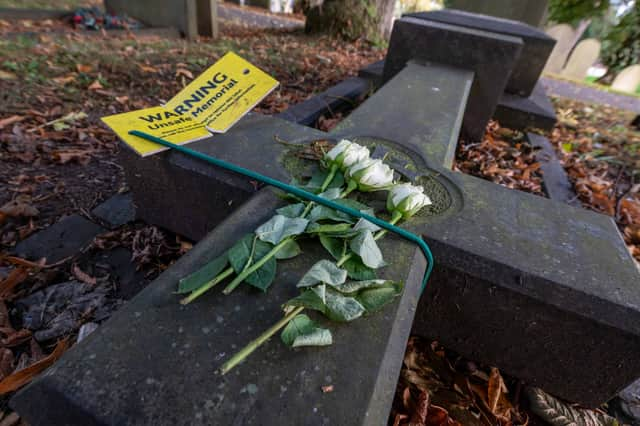

The council has a responsibility to make the cemetery safe from the risk of incidents such as the death of four-year-old Lancashire boy Eli Testa, who was killed by a collapsing memorial in July 2025.
Critics of DTC’s handling of the situation include Louis Hutchinson and Derbyshire County Councillor David Harvey who have both run for office as Reform UK candidates - Mr Harvey represents the Hardwick division at DCC.
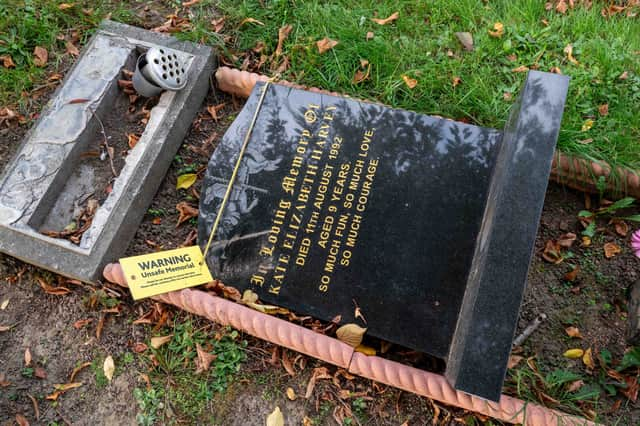
The cemetery contains the graves of beloved close relatives: for Louis, his grandmother Barbara; for David, his daughter Kate, who died aged nine in 1992 as a consequence of cystic fibrosis.
While Louis has tracked the cemetery work as it unfolded, for David first learned of the council’s actions when he visited to tend the grave with his wife Christine in early autumn and found it had already been laid flat.
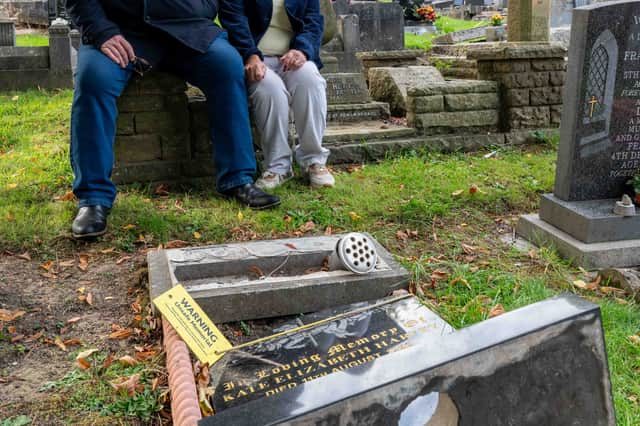
He said: “We moved from Dronfield to Glapwell a few years ago, so naturally we were visiting less frequently, but we must have been up there just before testing was carried out.
“It came as a hell of shock to find the headstone had been laid flat. I was stunned. It was installed in 1993 and it was still perfectly fine.
“There was nothing wrong with it at all. If I was kneeling by the grave and put my hand on it as I stood up, there was no movement. It was upright and safe.
“It felt like our daughter’s grave had been desecrated. I know that’s a strong word but that’s how it feels. I was one angry person and it took me a while to calm down.”
He added: “To see the state of the cemetery, with all the headstones laid low, was absolutely diabolical.
“I was disgusted, angry and annoyed to see this happen to so many others.”
It was only afterwards that David and Christine realised they had not updated their contact details in cemetery records when they left Dronfield.
DTC points out it published advance notification of the testing on its website, social media, noticeboards and in the cemetery itself in March 2026, encouraging grave owners to ensure their details were recorded correctly, and sent letters to those addresses it had on file.
Further notifications were issued via the same means in May and July with updates on the process.
The council said: “As contact information is not always available or current, the council therefore relied upon a combination of direct communication and public notices to ensure the inspection programme and subsequent actions were widely publicised.
“The town council owns and manages Dronfield Cemetery and is responsible for the management and upkeep of the cemetery as a burial ground. However, this responsibility does not extend to ownership of individual burial plots or memorials.
“Exclusive rights of burial are granted to plot holders (lessees) for a period of between 50 and 60 years, who retain responsibility for the condition, maintenance and safety of the respective plots and any associated memorials for that period.”
The Harveys are now in the process of having the stone reinstated by specialist masons at a cost of around £500, which David intends to try and recoup from DTC.
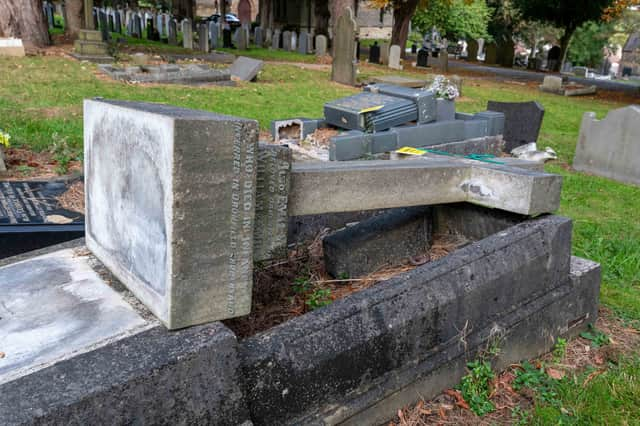
To date, 224 of the 438 at-risk memorials have been laid flat, with DTC saying: “This step was taken only where the council considered there to be exceptional circumstances and where repairs had not been completed within the notification period.”
As repairs are arranged privately by grave owners, DTC does not have a record of how many have been completed.
The council said: “Many of the older graves within the cemetery date back several decades and, in a significant number of cases, the council does not hold up-to-date contact information for a living grave owner or next of kin, the rights have expired or the lessee is in the grave.
“This has inevitably limited the council's ability to communicate directly with those responsible for arranging repairs.”
Louis and David were ejected from a meeting of the council’s cemetery committee in September, which they attended on behalf of the Friends Of Dronfield Cemetery, when committee chair William Jones reportedly “determined that the orderly conduct of the meeting was being adversely affected.”
Louis said: “I asked questions, so did David, and the council did not want to answer any more questions. We both remained calm but were asked to leave.”
David recalls: “I’m not sure we were asked to leave. It got quite heated in the meeting until the chairman said they were going to draw a line under it.”
DTC said: “The council has dedicated a substantial amount of officer time to responding to correspondence, complaints and Freedom of Information (FoI) requests relating to the memorial safety programme.
“Whilst the volume of enquiries has been substantial, it has largely arisen from a very small number of individuals.
“Whilst the council remains committed to transparency, accountability and compliance with its statutory obligations, this work has inevitably reduced the capacity available to progress other council business, statutory responsibilities and community projects during the six month period concerned.
“Importantly, the council has not received any formal complaints directly from lessees regarding memorials affected by the programme. The council remains satisfied that the programme has been undertaken sympathetically, proportionately and in accordance with its legal obligations.
“While the council fully respects the right of individuals to express their views and engage in public debate, it has a responsibility to correct misinformation where it may cause unnecessary concern, misrepresent the council's actions, or undermine public confidence.
“These requests are not intended to suppress legitimate opinion or criticism, but to ensure that public discussion is based on accurate information.”
David remains unconvinced, saying: “I think the council has made a mess of the whole damn thing and the hurt that it’s caused local residents - and others who have moved away and may not even be aware - is totally unnecessary.
“If I’d thought there was any danger I would have done something about it. I come from a civil engineering background where anything we do is through calibration and measurement.
“Apparently the only method used to test these stones in the cemetery was to rock them back and forth to see if they moved, and they did that with 2,387 headstones in two days. That’s quite some going.
“It’s a very subjective form of testing, and one councillor admitted to me it wasn’t very scientific. I’m quite speechless about what may or may not have gone on.”
Christine added: “It seemed very strange that there are so many old stones that looked like they could be dodgy and they’ve not been touched.
“The cemetery dates back to Victorian times and there are a lot of huge memorials, some of which are already leaning.
“They seem to have just gone for relatively new graves from the 1970s onwards, I think there was even one from around 2010.
“It feels like they went for all the ones that are still being looked after - where they might be able to find someone to pay for it.”
The council’s testing contractor, CDS Group, has previously not responded to questions over its methods from the Derbyshire Times.
DTC has previously said that neither they nor CDS regard the 18 per cent failure rate as unusual in comparison with testing sites elsewhere.
The council admits that video evidence exists of the tests carried out on all the failed memorials, but has declined to release footage even after an FoI request.
DTC said: “The information requested is contained within a large number of video recordings and is not held in a format that can be readily extracted.
“Each video would need to be reviewed individually to determine whether it contains identifiable individuals, whether any exemptions apply, whether redactions are required, and whether disclosure would comply with data protection legislation.
“This is not a simple retrieval exercise. The council has limited administrative resources, and compliance would significantly divert resources from other statutory and operational duties.
“It therefore determined that the request met the threshold for refusal under Section 14(1) of the Freedom of Information Act.”
Louis previously alleged failures in the cemetery’s drainage maintenance - and therefore the stability of the ground - which were rejected by DTC.
His family have not so far paid to have Barbara’s memorial reinstated after being quoted around £400 for the work.
Louis said: "When I first saw my grandma's grave lying flat, to be honest I was on my knees. I was that upset - just lying down in the dirt.
"She was 69 when she died and my great-grandma is buried there too. They spent all their years, all their lives, in Dronfield and this is how they have been treated."
He added: “We don’t think we should be responsible. We think the council caused this mess, and a lot of other families share the same opinion. How do we know the memorials were that bad?”
Louis has subsequently spent time researching some of the other memorials affected, finding a series of local lives he thinks should be remembered with more respect.
He said: “There’s PC Arthur Wright, who was born in Apperknowle in 1875 and died, on the day before his 36th birthday, trying to save a girl from the River Derwent in 1911.”
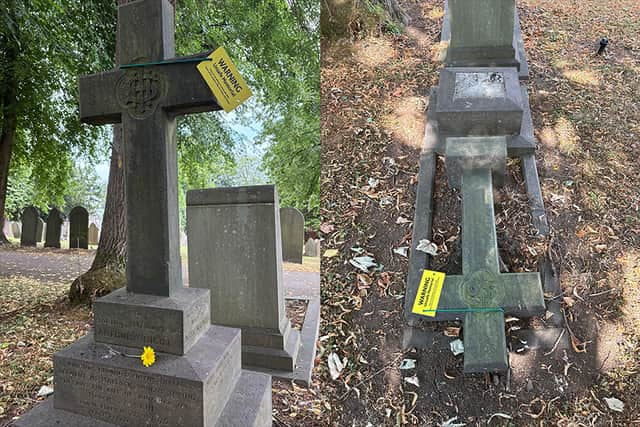
PC Wright is also commemorated on a stone in Matlock’s Hall Leys Park, near the scene of the incident.
He added: “There’s another memorial to Fred Margerrison who was killed in action in France in 1918; Reverend Michael C Quigley, who died in 1984 and was a parish priest of the Holy Spirit Church in Dronfield; James Wildgoose who died in 1897, he was on Dronfield Council and has an architecturally important memorial showing with an anchor and a cross meaning he was anchored in faith; there are so many more.”
Claims have also been laid against the council over whether it followed the necessary additional procedures for those graves in the consecrated section of the cemetery, which accounted for almost half of the stones deemed unsafe and 133 laid flat.
In response to queries from the Derbyshire Times, a spokesperson for the Diocese of Derby indicated that DTC had followed the correct initial procedure.
They said: “Dronfield Council applied for a faculty (a form of Church of England permission to undertake work in and around churches) in order to carry out safety inspections on the headstones and memorials in the cemetery.
“We are aware that a large number of headstones were laid flat and are investigating this further, we are speaking with Mr Hutchinson and will keep him updated."
DTC said: “The town council applied for and received permission from the Diocese of Derby to undertake the memorial safety testing within the cemetery.
“All work was conducted in accordance with the memorial testing proposal, risk assessment and advance notice of memorial testing documents submitted to the diocese ahead of the work.
“The town council has also submitted to the Diocese of Derby a list of the memorials laid flat in the consecrated section of the cemetery, as requested.
“The town council is satisfied that all relevant procedures relating to the Diocese of Derby and consecrated areas of the cemetery were followed.
“The council has also been in communication with the local diocese regarding concerns raised during the programme and has sought to address matters brought to its attention.
“The council remains committed to constructive engagement with all stakeholders and has carefully considered representations received throughout the process.”
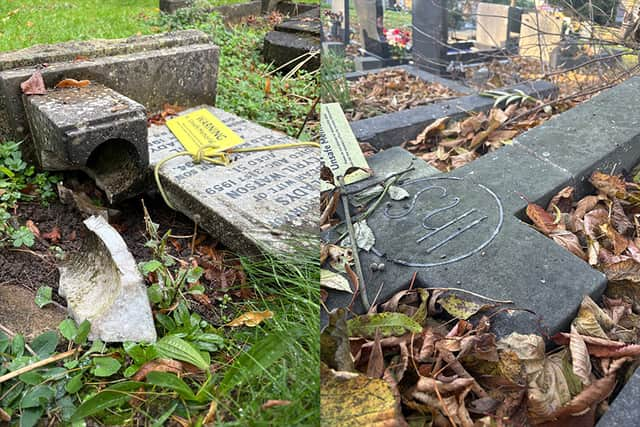
“The council considered available options for making memorials safe. However, Ministry of Justice guidance advises that routine staking of memorials is not recommended because it can create further safety risks and may cause damage to the memorial itself.
“It is important to emphasise that responsibility for maintaining a memorial in a safe condition rests with the registered lessee. Memorials are private property and are not owned by the council.
“The council's statutory duty is to ensure that the cemetery is safe for members of the public and those working within it. That duty exists alongside the responsibility of lessees to maintain private memorials in a safe condition.
“Where a memorial presents a risk of injury, the council has a duty to consider and, where appropriate, take reasonable and proportionate action to remove or reduce that risk.
“This action has been taken solely as a safety measure and does not prevent memorials from being repaired and re-erected in the future.”
Memorials were taken down by the council’s outdoor services team, rather than specialist stonemasons, though it is understood that two members of staff received memorial safety testing training through the Institute of Cemetery and Crematorium Management (ICCM), and two others via the company Cemetery Training Services.
According to the council, it has kept comprehensive records and only four memorials sustained damage during the entire testing process, “In each case, the damage was attributable to the age, condition and previously hidden structural weaknesses of the memorial concerned.”
One of those affected was the headstone of John Sheard, his wife and son.
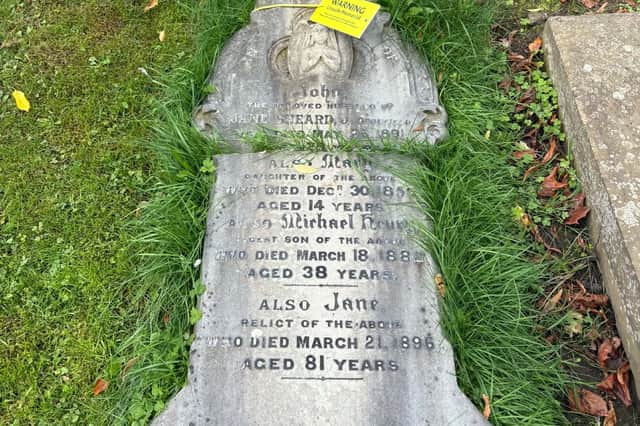
Recorded as the owner of Dronfield’s Victorian-era Gosforth and Gomersal collieries, Sheard senior is said to have died in an accident in 1891 where he was thrown from a horse-drawn trap.
The council said: “Four members of council staff lifted the headstone straight off its base and carefully placed it onto the ground, which is when the headstone cleanly broke into two pieces.
“The rights to the plot have expired and the plot is not registered with any living person, therefore the ownership of the plot and memorial has reverted to the town council.”
On the question of those more complex memorial piecess, Historic England recommends: “A thorough structural investigation will be needed before any works are carried out to identify the causes of deterioration … Generally monuments should not be dismantled unless absolutely necessary.”
Any requests regarding repair of those memorials damaged will be referred to the cemetery advisory committee for consideration at their next meeting.
DTC said: “The town council has taken advice from the Institute of Cemetery and Crematorium Management (ICCM) … guidance states that ‘whilst repair might be considered appropriate in areas where the appearance of the cemetery requires consideration, an authority is not obliged to spend excessive amounts of public money on private property and is only obliged to make memorials safe. The authority is empowered to make safe dangerous memorials.’
“The memorial safety programme has now concluded. In line with established cemetery management practice and industry guidance, memorial inspections will continue to be undertaken periodically, with the next full inspection programme currently anticipated in approximately five years, subject to operational requirements and any future changes in legislation or guidance.
“Having carefully considered its statutory responsibilities as a burial authority, sought and followed appropriate professional advice, had regard to the relevant guidance issued by the Ministry of Justice and the Institute of Cemetery and Crematorium Management, and completed the programme, the Town Council remains satisfied that it has discharged its responsibilities in a reasonable, proportionate and conscientious manner. The council considers this matter concluded.”