
Derbyshire council rejects maintenance concerns after hundreds of gravestones deemed unsafe
Dronfield Town Council has rejected concerns over its upkeep of the community’s cemetery after demanding the owners of hundreds of memorials and gravestones take action to make them safe.
All 2,387 memorials in the Cemetery Road burial ground were subjected to safety tests over three days at the start of April – following the council resolution to begin such checks every five years in light of 2019 legislation and the tragic case of Lancashire boy Eli Testa, who was killed by a collapsing memorial in summer 2025.
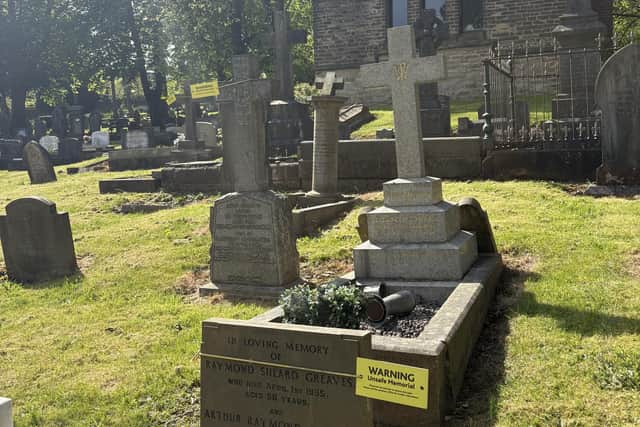
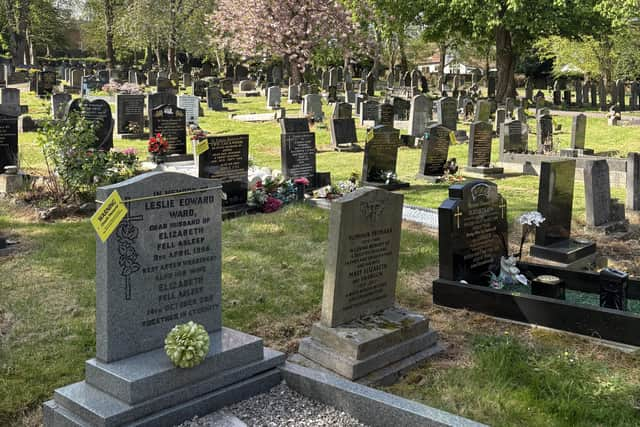
Given the cemetery has served Dronfield since 1877 it was inevitable some stonework would be worse for wear, but after the testers left residents were surprised to find that 438 memorials – around 18 per cent – had been deemed at risk of failure.
Retail worker Louis Hutchinson, 24, was among them when he visited the final resting place of his grandma Barbara, who was buried in 2002, and saw the plastic warning tags attached to so many gravestones throughout the site.
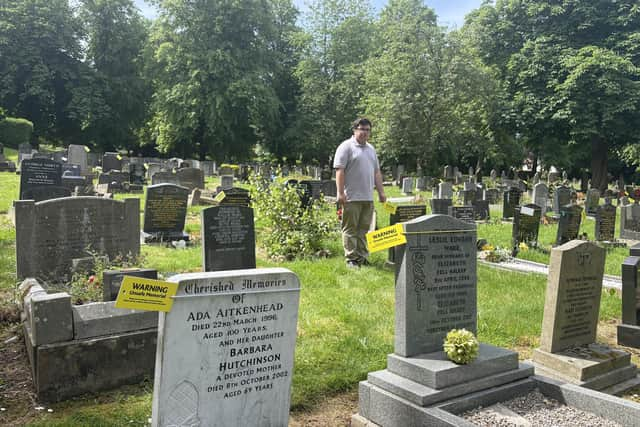

Louis said: “I’d understand if the stones were all a hundred years old but when I looked around, the most recent one with a tag was dated 2023. It’s hard to believe that something three years old would be failing a safety inspection.
“So many of them look in superb condition, and I just can’t imagine we’ve had that many bad stonemasons over the past 149 years, which seems to be what the council is saying now.”
In his disbelief, Louis began to wonder whether there may be an underlying problem which needed attention.
He said: “My grandma’s grave has a good quality headstone but for a number of years we’ve noticed it may be sinking. It has some edging stones around it too, and they’re more or less fully submerged in the ground now.
“I posted a comment about this on Facebook, and other people with relatives in the cemetery said they’d noticed similar things.”
Louis submitted a Freedom of Information request to the town council, asking for a copy of the testing report prepared by consultants CDS Group as well as all internal council documents related to the maintenance of the cemetery and in particular its drainage system.
The cemetery lies between residential streets on a slope above the River Drone, and recent years have seen concerns raised about flooding and drainage issues both up and downhill.
But Louis’s FOI request revealed that the only drainage in the cemetery is the original 1877 soakaways which channel water into the ground rather than a sewer or a natural watercourse.
According to council documents, its maintenance workers clean the soakaway grates once a year, although in 2023 an unnamed external company was drafted in to thoroughly clean the drainage gullies using high pressure water jets and vacuums.
An email chain related to the contract concludes with a message from the company saying: “We attended with a jet vac and managed to clean the majority of the gullies withing the cemetery, but as you said there was one or two that the truck couldn't physically get to.
“So a couple of weeks later we sent one of our smallest trucks to have a go, but even that couldn't get to them, without running on the grass/graves, therefore we have tried everything possible, I believe there is only about four gullies that didn't get done.”
It is unclear whether that work was ever completed. In response to questions from the Derbyshire Times, Dronfield Town Council (DTC) said only that the cemetery grates had been cleaned of debris most recently in January 2026.
A spokesperson said: “The council has never commissioned a survey of the site to ensure the drainage system remains fit and it is not aware of any legal requirements for it to do so.”
It is also unclear whether any potential instability in the land from excessive water build-up could have contributed to the failure of memorials.
There is no mention of ground conditions in the testing report, and the risk posed by individual memorials was judged simply by applying force to each one by hand – a process codified in 2018 by the British Standards Institution.
The council said: “The reasons for memorials failing the safety test was in the majority of cases due to issues with the memorial above the ground such as loose joints within the memorial itself.”
CDS Group did not respond to a request for comment but, according to the council, the company did not regard the 18 per cent failure rate as unusual.
In response to Louis’s questions to DTC, clerk Joanne Mitchell wrote: “We are not aware of any official guidance or legislation which states that a soil sample or investigation of the underground conditions is required when testing memorials.
“We are not aware of any requirement for the council to monitor slope stability. The responsibility for grave and memorial management lies with the grave owner, as lessee, not the council.
“Based on the results of the recent inspection the high number of tagged graves is in many cases due to the base of the memorial being unstable following installation by the appointed stonemason.”
By placing responsibility on the plotholder for each grave, rather than shouldering it as the landowner, DTC is also passing on the costs of solving the problem.
The council has written to plotholders – where they can still be identified in council records – instructing them to employ an approved stonemason to complete repair works, and any memorials which have not been made safe within three months will be laid flat on the ground.
Louis, whose 91-year-old great aunt Rita Hays has received one of the letters for Barbara’s grave, remains unconvinced by the council’s handling of the matter.
He said: “Obviously if the council admitted there was any land movement or a fault in the drainage, it would be quite a big financial problem for them.
“What concerns me is that people are going to pay stonemasons to come out and fix these memorials, and in five or ten years we’ll be back in exactly the same situation.”
A statement issued by the council said: “In 2025, a tragic incident involving the collapse of a memorial in a UK cemetery resulted in the death of a four-year-old child.
“This event and previous incidents brought national attention to the risks associated with unstable memorials and the responsibilities faced by local authorities in managing cemetery safety.
“The primary duty of any local authority is first and foremost to keep the public safe. Dronfield Town Council therefore has a duty to ensure the safety of all visitors, staff, and contractors within Dronfield Cemetery.
“While the council manages the burial ground, it does not own individual memorials; responsibility for the maintenance and condition of headstones and other memorials rests with the respective plot holders.
“The council recognises that memorial testing can be distressing for some families. However, it must balance that with a statutory responsibility to maintain the cemetery in a safe condition and to mitigate any risks posed by unstable memorials.
“All recent memorial inspections were conducted in accordance with the latest Ministry of Justice guidance, and advance notice of the programme was communicated through a range of channels.
“Where memorials were identified as unsafe, the Council has written to those plot holders for whom up-to-date contact details are available, requesting that repairs are carried out within three months.
“In line with Ministry of Justice guidance, any memorials that remain unsafe after this period may need to be laid flat to prevent potential harm.
“The response from the community has been positive, with many families already arranging repairs and updating their contact information to assist with future communications.”