
Plan for new electricity substation near Chesterfield to enable delivery of green energy in biggest overhaul of network in a generation
A site near Chesterfield has been earmarked for a new electricity substation as part of The Great Grid Upgrade, a major overhaul of the UK network that will enable the country to connect 50GW of green energy by 2030.
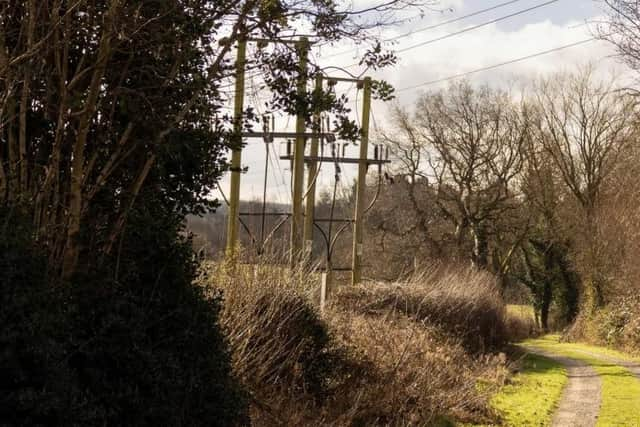
National Grid is applying for planning permission to erect a 400kV Gas Insulated Switchgear (GIS), three super grid transformers, gantries, internal access roads, a GIS building, parking, drainage, diesel generator, lighting and CCTV on a site south of Calow Lane, Calow. The plan includes a permanent access road from Calow Lane and the permanent diversion of two public rights of way.
The proposed substation would be within a compound of approximately 150 metres x 165 metres, the size of around three and a half football pitches,
Part of the 14.5 hectare site is occupied by an existing 275kV National Grid substation and most of the remainder of the site is agricultural land, located to the south of an existing 132kV substation which is owned and operated by National Grid Electricity Transmission.


As part of the planning process, National Grid shared information on the proposal with the public in 2024. The consultation included delivering letters to 324 addresses and a social media campaign. There were two public drop-in events that year, attended by a total of 49 people. A total of 17 feedback responses were received. Overall, the feedback emphasised the need to minimise environmental impact, reduce visual intrusion and integrate the project with the landscape. Key issues included ensuring construction traffic uses designated routes to avoid single-track roads, addressing safety concerns due to poor visibility and speeding on local lanes, and making repairs for any damage caused.
On January 13, 2026, the Environment Agency wrote to North East Derbyshire District Council about the application, stating: “We object to the proposed development as submitted because it involves the use of a non-mains foul drainage system in circumstances where it may be feasible for the development to be connected to a public sewer but inadequate justification has been provided for the use of a non-mains system. We recommend that the application should be refused on this basis.
“Private sewage treatment facilities should only be used where it is not feasible for a development to be connected to a public sewer, because of the greater risk of failures leading to pollution of the water environment posed by private sewerage systems compared to public sewerage systems.
“This objection is supported by the Planning Practice Guidance (PPG) for Water Supply, Wastewater and Water Quality which advises that the first presumption must be to provide a system of foul drainage discharging into a public sewer. Only where, having taken into account the cost and/or practicability, it can be shown to the satisfaction of the LPA that connection to a public sewer is not feasible, should non-mains foul sewage disposal solutions be considered.”
Planning consent was given for a new 400kV electricity substation on the same site in Calow in 1997 but the permission was not implemented by National Grid. The approved scheme was resubmitted in 2002 and recommended for approval but NE Derbyshire District Council’s planning committee refused it on the grounds that the site was in an open countryside location, in close proximity to a number of dwellings, and would significantly increase the size and presence of the substation. Planning applications relating to the site or immediate proximity state that consent for the first 132kV electricity substation was granted in 1957.
A lengthy planning statement, submitted to North East Derbyshire District Council in support of the current application, reports: “There is a recognised, urgent need for new electricity and distribution infrastructure in the UK.
"The UK government has committed to reach net zero emissions by 2050. This means achieving a balance between the greenhouse gases put into the atmosphere and those taken out. Decarbonising the energy system is vital to achieve net zero; the fossil fuels that once powered the economy are to be replaced with sources of low-carbon electricity.
“There is an increased growth forecast in offshore wind capacity in Scotland and the North East of England, as well as increasing power flows to and from European power grids. This would put pressure on the existing network, such that reinforcement of the transmission network has been identified as necessary to secure the operation of the transmission system and ensure reliable, economical and long-term supply.
“To achieve this, National Grid needs to upgrade the high voltage power network in England to connect these new sources of offshore energy to the energy network. These plans are part of the biggest overhaul of the energy network in a generation.”
The proposal for Calow forms part of the Brinsworth to Chesterfield and Chesterfield to High Marnham project, which is referenced in a report by the National Energy System Operator as one of the four schemes which will provide significant additional capacity on the network to facilitate flow from north to south. The project needs to be delivered by 2030 to enable an affordable and secure clean power system.
National Grid’s planning statement to the council reads: “The development of a new substation will enable National Grid to uprate the existing 275kV overhead lines between Chesterfield and High Marnham to operate at 400kV between the new substation at Chesterfield and a new substation at High Marnham. The development of the new substation will also support National Grid’s uprating of the existing 275kV overhead lines to operate at 400kV between Brinsworth, a new substation at Long Lane (in Brinsworth) and Chesterfield. This will allow additional power to flow through the grid, transferring green energy from where it is generated to where it is needed.”