
Derbyshire group reveals plan to cover car parks with community-owned solar farms
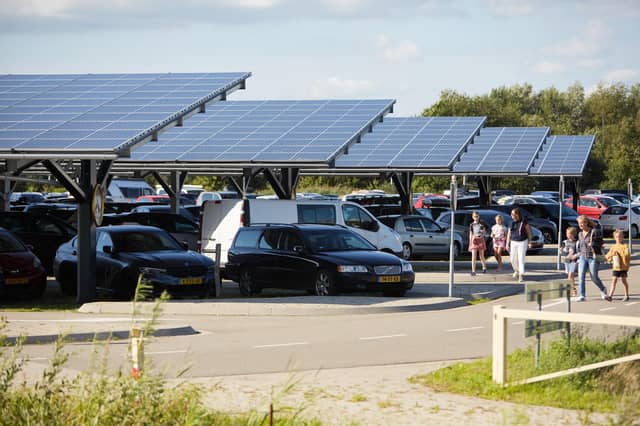

If this weekend’s Government announcement of major investment in green energy jobs and infrastructure could stumble over Derbyshire County Council’s opposition to solar farms, one innovative group is already thinking ahead to an alternative solution – building solar canopies over public car parks.
Unveiling plans to train an extra 400,000 people in renewables and other green industries by 2030, energy secretary Ed Miliband described the policy area as “a massive fight with Reform UK” – illustrated by Derbyshire councillors’ vote earlier this month to oppose large-scale solar-panel farms and battery energy storage systems on greenfield sites.
At the time, county leader Alan Graves said: “We are clear as a council that rural Derbyshire will not stand idly by whilst good, usable agricultural land is sacrificed at the altar of Net Zero and turned into a Chinese manufactured eco desert.”
But Derbyshire Dales Community Energy thinks it has come up with a one way to satisfy both camps.
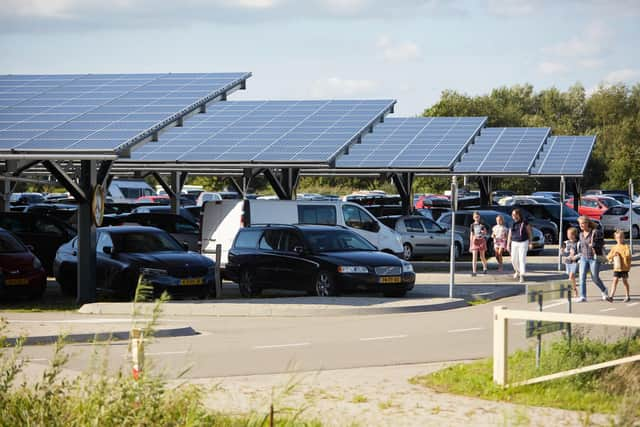
The award-winning community benefit society, which has pioneered small-scale solar and hydro-power schemes in semi-rural areas in recent years, says it has recently completed a viability assessment of car parks in Matlock and Bakewell – most owned by Derbyshire Dales District Council – where photovoltaic panels could be erected over the parking spaces.
Bakewell resident Jonathan Ainslie, who is managing the project, said: “This is in a meeting place between the environmental groups who have been working to get more renewables up and running, and those looking to quash developments on farmland.
“Loads of buildings in our historic towns are subject to planning restrictions, or have structural problems like asbestos that make roof-mounted panels unfeasible.
“Having selected as many as seven workable sites for our new solar canopy designs already, we could soon be generating really meaningful amounts of electricity on brownfield land, rather than plonking new panels in fields or green space across the national park.”
Car park solar farms are becoming increasingly common around the world – France has made them mandatory for sites of a certain size – but DDCE believes this would be the first community-owned project of its kind in the UK.
Jonathan said: “It’s tried and tested stuff, it just hasn’t really come to the UK yet. There are very few that I know of.”
The team is currently pursuing grants for the next stage of the process and hopes to release more information – including the locations selected – by the end of the year.
Jonathan said: “We’ve started to narrow down the number of car parks to see what we can make work, because the final cost will be several million pounds.
“There’s been no agreement with the council yet on specific sites, and no pledge of council money. All the work is being done by us.
“It’s really exciting to see the project develop from these early stages, and the final canopy designs might soon get to be tested in a working prototype.”
Anyone familiar with solar car parks elsewhere, or trying to imagine one, might picture a single vast-canopy covering a whole site which could look alien to an architectural landscape like Matlock, but DDCE envisages something more modest.
Jonathan said: “There are various options for the design, for instance some with panels that cover one space each, others with a gull-wing shape to cover two spaces.
“There are all sorts of factors in making sure the look complements the surrounding area and passes planning permission, and then there are decisions based on carbon costs – like whether we use steel or other materials.”
As part of the initial study, DDCE carried out local polling which found significant support for the idea, and they are keen to build on that enthusiasm while work continues in the background.
The team is offering a promise of low-carbon, low-cost electricity to partner businesses, the opportunity for local investors to make a return, and wider benefits including more charging points for electric vehicles, free-to-run CCTV, shaded parking in summer and profits reinvested in other community enterprises.
Part of the site selection process will involve identifying those car parks whose neighbours’ electricity demands best match the supply.
Jonathan said: “These sites can generate a lot of electricity so to make it viable we need several local ‘off-takers’ who have reliable needs – a supermarket would be a good example, or a factory.
“For the 30-year lifespan of the panels, we’d then give them a set rate of guaranteed electricity, cheaper than the market price, generated on their doorstep without the need to go through intermediaries or all the usual market fluctuations.”
He added: “What usually happens is an organisation like the council would lease the rights for the site to another company, and they would take all the profits but we want the community to own these assets.”
For more information on the project and ways to get involved in Derbyshire Dales Community Energy’s other work, go to ddce.org.uk.