
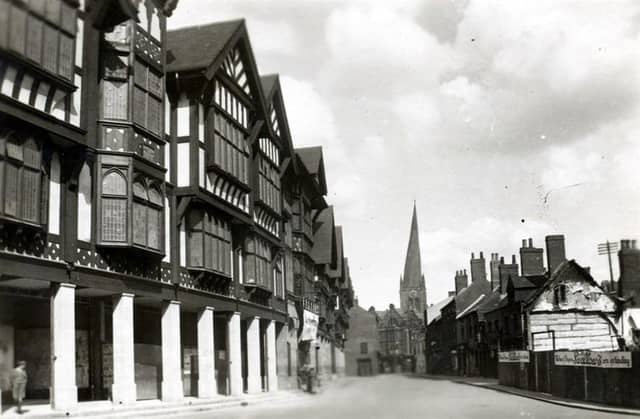

There are about 45 in the town centre alone due to a major 1920s and 1930s rebuilding project.
These Tudor Revival, or Mock Tudor buildings were influenced by the Arts and Crafts movement and a desire to create a uniform look for the town. Percy Houfton, architectural advisor to the council, was a particular supporter of the movement.
Chesterfield’s first black and white building North Lodge in Queen’s Park, was actually built in 1891. It was designed by architect and town councillor, Samuel Rollison and built before alternative plans for the park were adopted.
The designs of black and white buildings changed over time. In the 1920s they were half timbered but by the 1930s the black and white element was reduced with brick featuring more. By the late 1930s brick and stone dominated once more.
Knifesmithgate
The most striking series of black and white buildings in Chesterfield is on Knifesmithgate. The widening of the road and its extension to the west in the 1920s saw the demolition and redevelopment of many of the buildings.
The largest project was the Victoria Complex. The existing cinema, the Victoria Picture Palace, and the billiard hall were reconstructed and the complex redeveloped to include a café, restaurant and a large ball room as well as shops and Barclays Bank.
The new cinema and billiard hall opened in 1924 but it took until 1930 for the rest of the building to be completed.
Swallows was a long standing drapery business on the corner of Knifesmithgate and Packer’s Row. The building was rebuilt in 1930 with a black and white façade. Swallows closed in 1970 and the site was redeveloped.
Many of the black and white buildings in the town were originally pubs. In the 1920s, licensing laws were being strengthened. Public houses could be closed down if they were not ‘fit for purpose’.
As a result it was in the best interests of the brewery companies to rebuild several of the town centre pubs at the same time as the street improvements in Chesterfield were being carried out.
The Lord Nelson on Cavendish Street was last black and white pub in the town to be built and one of the largest owned by William Stones Brewery.
The plans for the Red Lion on Vicar Lane, submitted by the brewery, William Stones, in 1914, described it as ‘the Old English style’. The pub closed in 1989 and was demolished ten years later as part of the Vicar Lane shopping development.
Timber framed buildings
Many black and white buildings are not actually fully timber framed and are simply half timbered or have a ‘surface only’ design.
There are only three true timber framed buildings in Chesterfield. The oldest is the former Peacock Inn on Low Pavement, built around 1500. The second is the Royal Oak pub in the Shambles, part of which was built in the sixteenth century. The third is a former coaching inn, the Falcon, on the corner of South Street and Low Pavement.
The Royal Oak building has undergone many changes and roles throughout its life. The first mention of its use as a pub is 1772 but parts of it have also been used as a house and butchers shops. It is now a Grade II* listed building.
After purchase by William Stones Brewery in 1897, the Royal Oak underwent extensive renovation. Many rotten timbers were replaced.
For many years the timber frame of the Peacock Inn was hidden behind a plaster façade. It was only after heavy restoration in 1978 that the timber construction was revealed.
The Peacock was a larger building when originally built, it was possibly a public building of some kind but by the 1680s, it was a private home to a wealthy family.
Despite being a timber framed structure, the black and white features of this building are not the actual frame but a nineteenth century addition.
Developing the town
In the 1920s and 1930s Chesterfield Corporation undertook an ambitious programme of street improvements in the town centre. The narrow streets were completely unsuitable for cars, buses and trams.
Knifesmithgate was extended, Vicar Lane was widened and a new road, Church Way, was built. The project required a lot of redevelopment and many of the black and white buildings in the town were built at this time.
The Chesterfield Corporation Improvement Bill in 1913 proposed 24 street improvements and work began on Lordsmill Street. The outbreak of the First World War in 1914, brought the project to a halt. Work did not commence again until 1919.
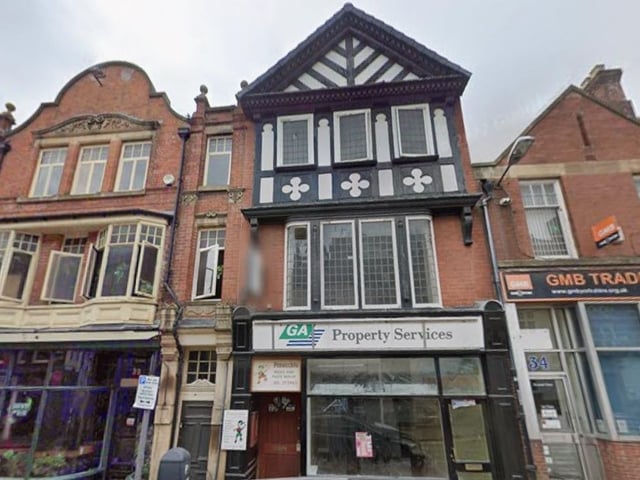
5. 32 Glumangate, Chesterfield
Narrow 3-storey brick building with mock Tudor upper storey façade with pediment gable and leaded lights. Photo: Google
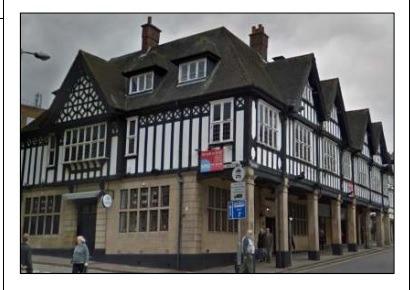
6. Former Queens Head Hotel and former Co-op store, Knifesmithgate, Chesterfield
Given the ‘Queens Head Hotel’ lettering in the leaded light ground floor window this building was presumably constructed as a hotel. A prominent mock-Tudor building on Knifesmithgate. Photo: CBC
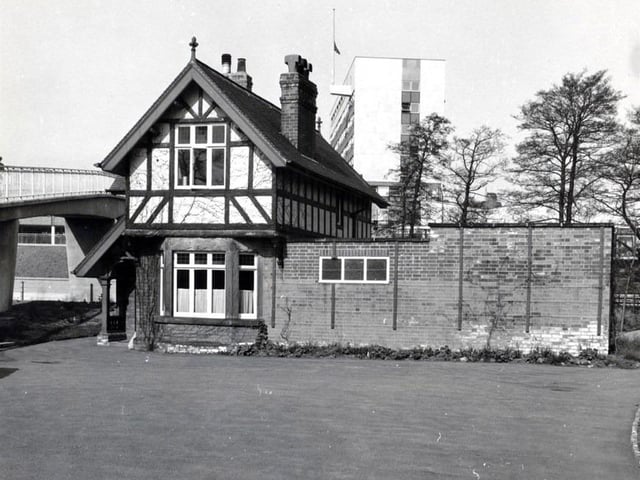
7. North Lodge
Chesterfield’s first black and white building was actually built in 1891. North Lodge (shown above) in Queen’s Park was designed by architect and town councillor, Samuel Rollison. It was built before alternative plans for the park were adopted. Photo: Chesterfield Museum service
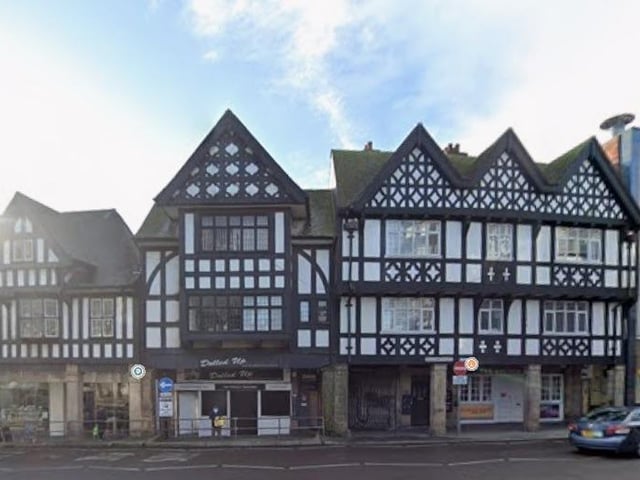
8. 22 - 26 Knifesmithgate, Chesterfield
Three connected but separate mock-Tudor properties (aka Black & White buildings) on Knifesmithgate dating from the 1930s. Cumulatively these and other mock-Tudor buildings in the town centre (primarily the facades) contribute significantly to the character of the town centre. Photo: Google