
'I'm really proud of the life I’ve built, but being disabled and chronically ill is incredibly hard' says Chesterfield artist speaking out on proposed change to welfare benefit
“I need PIP to survive but I hate being on it because it’s such a dehumanising experience. It's cruel by design - it is designed to be the worst it could be to put people off from applying in the first place. That is the reality for so many disabled people,” said Bella Milroy.
The 33-year-old Chesterfield artist, who has a complex neurological condition, slammed the Government’s proposal to tighten up eligibility to disability benefits in a bid to save £4.2billion. She said: “It is a demonstration of Labour’s complete lack of moral compass.
"There are plenty of people who are really poorly who can't access paid work because they are disabled. The way that I have been able to carve out a career as an artist is networking online; I am very geographically isolated from cultural centres so being able to do that has been an absolute lifeline. I can’t work more than I do...without PIP, I wouldn’t be able to live.”
Life can bechallenging for Bella. She said: “I am in chronic pain, chronic fatigue and I have very limited energy. I use a powered wheelchair and I am ambulatory and can walk so I use a walking stick as well. I love my life and am really proud of the life I’ve built, but being disabled and chronically ill is also incredibly hard and often it’s a real struggle. It’s also very expensive.
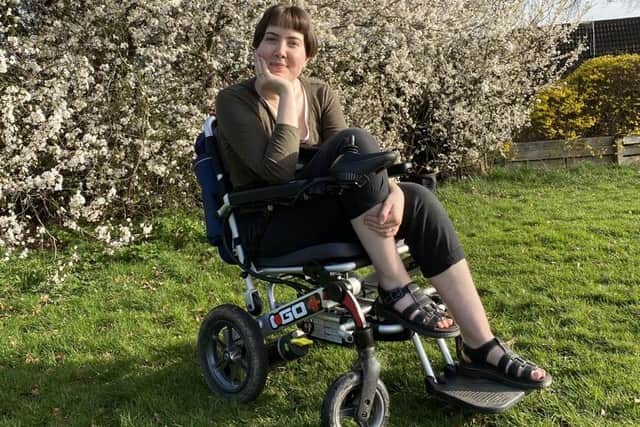

"I contracted viral meningitis when I was 21 and went from not disabled to pretty much disabled overnight. It was horrible – all the doctors said I would be fine and I’d make a recovery but I never did.”
Bella started claiming PIP (Personal Independence Payment) in 2014 but the following year it was revoked. She said: “When it happened it was like being made redundant but instead of being made redundant from a job, it was my life. I had to fight and was awarded it about eight months later. That is how PIP is structured…it relies on people giving up fighting for it because most people are exhausted, most people’s lives are very difficult and they don’t have the energy to push back when they are denied it. Fortunately I have very robust support from my loving partner and my family and friends which means that I've got that help when we are met with terrible decisions like that.”
There are two components to PIP – the daily living part, if a person needs help with everyday tasks and the mobility part, if they need help to get around. In the daily living section, points are based on a person’s ability in 10 categories including preparing food, washing and bathing, dressing and undressing and budgeting. Currently a person who receives between eight and 11 points in total will get payment at a standard rate. If they get at least 12 points they will get an enhanced rate.
Under the Government’s plan, the eligibility would be tightened to include a minimum of four points on a single activity in the daily living part. The Government said the proposed change would mean ‘that people who only score the lowest points on each of the PIP daily living activities will lose their entitlement in future’.
Bella said: “I suspect that I will be faced with an even more violent and oppressive system that is already extremely difficult to deal with. I suspect that they will work even harder than they already do to not give me the award.”
The number of working age PIP claimants has doubled from 15,300 to 35,1000 a month in the past five years. Bella said: “The Government are pushing back against more claimants of PIP and we're five years on from a global pandemic, one of the biggest mass disabling experiences that the world has ever seen.”
As a creative practitioner, Bella has championed the work of disabled artists. She said: “In 2021 I curated a really large-scale project across Derbyshire libraries which exhibited disabled artists exploring how they experience different mobility aids and devices in everyday life – that was called Mob Shop.
"Last year I curated a programme at Level Centre called Further Afield – an online programme featuring disabled artists who are rurally based, exploring their practices in contemporary art and how that intersects with their experience of disability.”
She is currently working towards an exhibition of her work in the Grand Union Gallery in Birmingham where her large-scale drawings will be on display later in the year. "I have an interdisciplinary practice – photography, writing, curating, drawing and sculpture,” said Bella. “I was an artist before I started making money from it and I’ll be an artist until I die.”
To find out more about Bella’s work, go to www.bellamilroy.com