
'I am so grateful for this wonderful result for the village and pray that this beautiful farmland is preserved for future generations' - campaigner's joy as inspector dismisses appeal for solar farm in Derbyshire
Campaigners who fought to protect countryside from the threat of a solar farm are delighted that an appeal into refusal of planning consent has been dismissed.
A national planning inspector has backed North East Derbyshire District Council’s decision not to grant permission for the development on 66 hectares of farmland north of Stretton Road, Morton.
Cllr Kevin Gillott, who represents the village on the district council, said: “This is great news for Morton. The campaign was about protecting a valued piece of local countryside, not opposing solar farms. There are three solar farms next to this site already, but this one was just too big and too close to village. Had it gone ahead, it would have changed Morton and the communities’ ability to enjoy the countryside that surrounds the village. It was a hard fought battle, and whilst I may have helped, its success was down to the commitment of the local community and their passion for the village.”
Becky Spackman, founder of Stop Morton Solar Farm group, said: “I am so grateful for this wonderful result for the village and pray that this beautiful farmland is preserved for future generations. The people of Morton have demonstrated their love for their village and its integral heritage and landscape, something that binds us together as a community and gives us a shared sense of identity.”
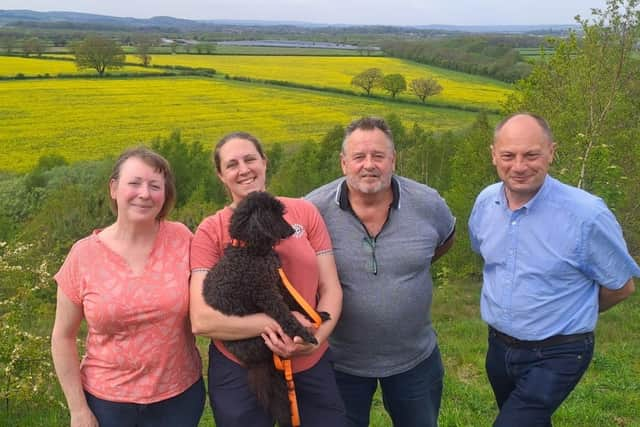

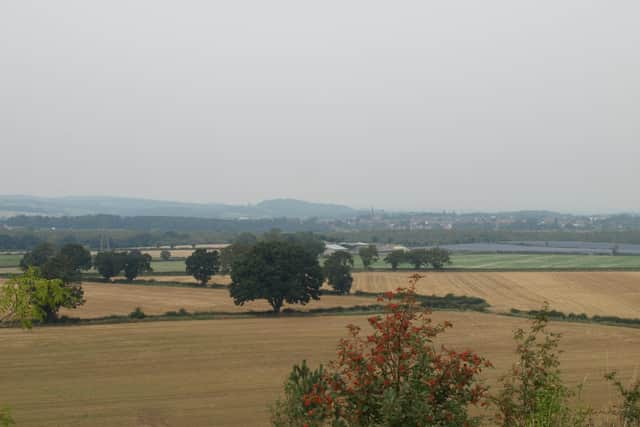
Becky found out two years ago that there was a plan to blanket 160 acres of a 200-acre working farm with battery energy storage units. She said: “I was horrified and stunned at the thought of what this would mean for our farmer and his family, the beef herd they kept and the wildlife on the farm. In addition this was the decimation of the view from our vantage point, the top of the old Pit Tip which has been landscaped and re-wilded along with a bench in memory of the men who were lost in our local pit giving a place for reflecting, a short stroll allows us to take in the spectacular rolling fields of the farmland with all its changes throughout the season.
"The thought of losing all this in favour of a heavily industrialised landscape of thousands of solar panels marching in uniform across the landscape, a hemmed in tunnel of three metre high fencing where the bridlepath through the farm once gave views of rolling greenery and crops, the hum of battery storage plants instead of the silence broken by beautiful bird song, the inevitable loss of all the larger mammalian wildlife due to the inaccessible fences and all the disruption and massive vehicles rolling constantly through our tiny village during construction was difficult to contemplate.” Becky started the Stop Morton Solar Farm group, with the help of her friend Sarah Barraclough. She said: “We both live on the lane that becomes the bridlepath through the farmlands and regularly use the path along with friends, family and neighbours.”
They opened a bank account, applied for grants, organised meetings, met with parish and district councillors, leafleted homes and researched the complex legislation surrounding solar applications in order to provide everyone who wanted to object with the information they needed to submit objections that had legal relevance.
Becky said: “A team of six – myself and Eddie White as village representatives, Sarah Barraclough and Neil Radford on behalf of the parish council, and Kevin Gillott and Andrew Cooper our district councillors, supported by other members of the village, attended the planning meeting at the North East Derbyshire District Council on May 20, 2025 to fight the proposal which had been recommended for approval by the planning officer. At the end of the meeting, the planning committee voted 10 to 1 against the proposal because they had identified the harm into would inflict on the local community and the damage to the landscape and amenity.”
But it was a victory that the campaigners knew would be challenged by the renewable energy company that submitted the application. An appeal was lodged and the campaign group resumed its fight after learning that the district council intended to defend its decision by employing specialist consultants for the appeal hearing.
The appellant, RWE Solar and Storage UK, amended its plans and requested that the appeal be determined on the basis of the changes. Amendments included the inclusion of additional hedgerow planting and accommodating the reintroduction of field boundaries on their historic alignments, extending the previously proposed permissive footpath route looping along the land parcels to the east of Evershill Lane/Public Right Of Way, information boards along the permissive footpath route and additional orchard tree planting in one of the fields.
Becky, Sarah, Neil and Kevin attended the appeal hearing in March 2026. Becky said: “It was extremely thorough, spanning around six hours and we we were allowed to speak at all times during the proceedings which allowed us to present many facts and concerns to the inspector Lora Hughes.”
Following the appeal hearing, the inspector reported that the proposal would have a major adverse visual effect from the colliery tip, a major adverse visual effect along Evershill Lane and the Public Right Of Way, a moderate/major landscape effect on the site and its immediate environs, and a moderate landscape effect on its wider environs. “Overall, the proposal would be significantly harmful to the character and appearance of the area,” she wrote.
The appeal nspector said in her adjudication that the description of both benefits and harm as ‘significant’ indicated that the planning balance in the case was finely balanced. “The extent of the benefits is intrinsically linked to the extensive scale of the proposal,” she wrote in the lengthy report. “However, I ultimately find that the harm resulting from that scale would be excessive to the extent that it does ‘tip the balance’, due to the several contributory elements of that harm. This is the key deciding factor in my decision in terms of layering of harm. This results from the effects on multiple viewpoints and experiences of the countryside, linked to that landscape character and its relationship with and value to the village of Morton and its residents, and the particular impact on persons with protected characteristics of disability and age.
“I find that the harm resulting from the appeal proposal carries determinative weight in this instance, such that in totality it would outweigh the identified benefits.”
Becky said: “This decision cannot be appealed against again, nor can another scheme of a similar scale or nature be imposed on the village now that the potential for harm has been identified.”
A spokesperson for RWE Generation SE said: “Following the refusal of our planning application and the subsequent dismissal of our appeal, we are naturally disappointed with the outcome.
“Throughout this process, we have worked to ensure that our proposal was carefully considered, responsive to feedback, and aligned as far as possible with local planning policies and community context. We respect the decision reached, although we do not fully agree with the conclusions drawn.
“We will now take time to review the decision in detail. We would like to thank those who engaged constructively during the process.”