
First sighting of Asian hornets in East Midlands as nest discovered in Chesterfield

Residents have been warned to be on the look out after the invasive Yellow-legged - or Asian - hornets were identified in Chesterfield
National trade body British Pest Control Association (BPCA) has reiterated the importance of correct identification to help prevent the spread of Yellow-legged hornets, which are a classed as an invasive ‘alert’ species by the Non-Native Species Secretariat and which pose a significant risk to native honeybees.
Yellow-legged hornets were spotted for the first time in the East Midlands in April.
An embryo nest was discovered in Chesterfield on April 26. Insects were intercepted at Repton in South Derbyshire and Rushcliffe in Nottinghamshire the following day, according to the National Bee Unit.
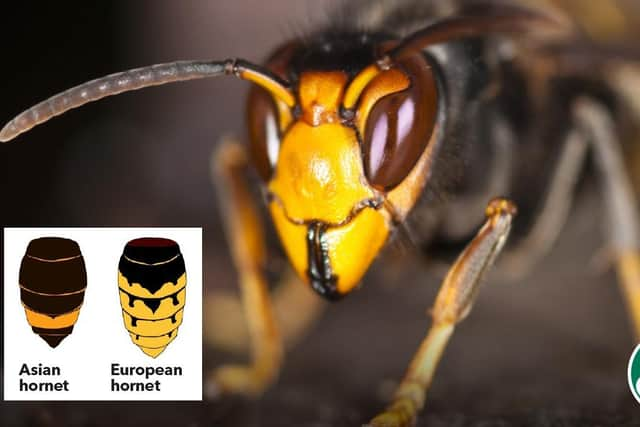

Niall Gallagher, Technical Manager at British Pest Control Association, said: “The Yellow-legged hornet is an invader that was first reported in the UK in 2016.
“It is a predator of honeybees which could disrupt our native ecosystems and impact crop production.
“To the untrained eye, it can be difficult to tell the difference between bees, wasps, native Europeans hornets and Yellow-legged hornets, but accurate identification is crucial to understanding and preventing the spread of this invasive species.
“The Yellow-legged hornet is smaller than our native species. It has an orange head, and its entire body is almost entirely dark.
“The abdomen has fine yellow stripes and a yellow or orange segment near the base. Their legs are dark and have yellow tips.”
Native European hornets are larger than Yellow-legged hornets at 3-4cm long, with a yellow head at the front, a reddish brown or black thorax and legs and a yellow abdomen with black stripes.
Like bees and wasps, hornet stings can be very painful and may result in red swelling and a burning sensation.
In rare cases a sting can trigger anaphylaxis which can be fatal. If anaphylactic shock is suspected, always dial 999.
Niall added: “Any sightings of Yellow-legged hornets should be reported to the Non-Native Species Secretariat either via their website, which also features identification information, or via the Asian Hornet Watch app.”