
Derbyshire Law Centre reduces employment legal advice service after county council withdraws £90,000 funding
Derbyshire's only legal charity supplying free specialist employment advice has warned of the significant impact that funding cuts will have on its service.
The county council has withdrawn £90,000 in discretionary funding from Derbyshire Law Centre, of which £29,600 was ringfenced for employment including paying for caseworkers. The majority of the funding helped to support essential business functions and vulnerable client cases not eligible for Legal Aid.
In 2023/24 the Chesterfield based law centre received 1066 employment enquiries (second only to housing), which represented around a fifth of its total enquiries. The employment unit secured £354,901 in out of court settlements and tribunal judgements for its employment clients.
As a result of losing county council funding this year, the former three-strong employment unit team now consists of one solicitor supported by assessment volunteers, there has been a 50% reduction in telephone callbacks, the service is limited to initial telephone advice and cases are only being taken on in exceptional circumstances.
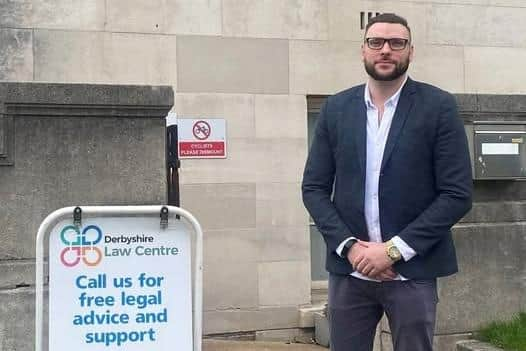

The centre still provides a low cost option for different aspects of employment law such as settlement agreements and supports clients who have experienced discrimination at work if the person falls within the Legal Aid calculation. But continued cuts and pressures on the sector mean that the service remains under threat.
Patrick Macken, a qualified solicitor with nine years’ experience in employment law, is now the only employee in the centre’s specialist unit which he has led since 2023. Patrick said: "The withdrawal of the funding will mean that primarily, Derbyshire Law Centre will only be able to assist clients on a chargeable basis, and whilst our hourly rates are considerably less than most private practice solicitors, they may still be unaffordable for most clients who are typically either in receipt of sick pay, completely exhausted sick pay or are unemployed due to dismissal.
"Further, due to restrictions with Legal Aid Funding, we would only be able to assist clients in respect of employment discrimination, who are financially eligible for Legal Aid, but this is means tested so their income has to fall below a threshold that hasn't been increased since 2009 and we've seen a 40% increase in inflation since then. Many clients, even those on a relatively low income, will 'fall in between the cracks' and have pure employment law issues that are not covered by Legal Aid, and not viable to fund privately. This is of particular concern given the Labour Government's intention to strengthen employee rights, such as increasing time limits to present claims, and 'day 1' rights for employees to claim unfair dismissal (as opposed to the current requirement to have worked for two years).
"If someone has experienced discrimination at work and they're eligible for Legal Aid Funding then we can help them but even this contract is limited in how financially viable it is. The overall impact on the working community might not be felt immediately but will be significant.”
Employment advice is available through ACAS, Citizens Advice Bureau or though trade union membership. But without a full employment service at the law centre, Derbyshire residents will find it harder to get specific and complex, free legal advice if they’re going through the tribunal process.
Patrick said: "We’re constantly working with councillors to reinforce how important the service is to local people. Being in secure employment helps to prevent other more serious issues like debt and housing difficulties developing. Investing in this type of support is a preventative step which helps to build a more resilient community.”
Since the cuts were first proposed, the law centre has petitioned the county council but so far without success. Patrick said: “We worked alongside Derbyshire Voluntary Action and their campaign to stop the cuts and we're continuing to work with different local authorities to maintain relationships and keep the focus on helping people access justice."
A spokesperson for Derbyshire County Council said: “As a council we have funded many voluntary organisations without any competitive process with annual grants for up to 20 years, with the Derbyshire Law Centre receiving two grants which totalled over £90,000 per year.
“Due to considerable and well-documented financial pressures facing the council which are beyond our control, we have had to consider whether we can afford to keep awarding discretionary grants of this nature that we have no legal obligation to give, against prioritising spending on services we have to provide by law.
“Following a review of all voluntary and community sector grants, which included a 12-week public consultation, a final decision was made by our Cabinet at the end of last year that corporate services and transformation discretionary grant funding would end on 31 March 2025.
“When receiving these annual grants organisations are told that they should not expect to receive them beyond agreed funding periods.
“We must ensure we’re supporting people fairly across the whole of Derbyshire and we have to ensure that our finite resources are targeted at services we are required to deliver by law to those people who need us most.”
Case studies
Derbyshire Law Centre has shared the following case studies from 2024:
1.Samantha contacted the law centre after discovering that her employer of 20 years was trying to shut down the company without paying her.
In an initial call the law centre advised Samantha that she was entitled to notice pay, outstanding wages and unless her employer dismissed her properly that she would be entitled to make a claim for unfair dismissal. The law centre provided a letter of advice regarding her case and immediately applied to halt the legal action to close the company, which could have resulted in Samantha being left without any legal recourse. On Samantha’s behalf the law centre applied to ACAS for early conciliation and when this was unsuccessful, assisted her with making a claim to the employment tribunal. Because of the exceptional nature of Samantha’s case, the law centre represented her at the employment tribunal and was successful in securing her a tribunal award in excess of £40,000. 2. Ashley is a young dad with autism. He came to Derbyshire Law Centre after being dismissed due to performance. The law centre advised Ashley that his employer had not implemented reasonable adjustments or considered what could have been implemented before dismissing him. Ashley instructed the law centre to issue proceedings at the employment tribunal. The employer denied that Ashley was disabled and the matter had to be decided by a judge. The employer argued that autism did not meet the definition of a disability under the Equality Act 2010 because Ashley has coping mechanisms for the symptoms of his autism. However, with the representation from Derbyshire Law Centre the judge decided that Ashley was disabled. After this decision the employer made an offer to settle the claim which was accepted.