
Derbyshire family says energy sub-station plans will destroy their home and land
A desperate family has told how plans for a new energy substation in countryside near a Derbyshire village as part of National Grid’s pylon roll-out scheme will destroy their home and land.
NE Derbyshire District Council’s planning committee agreed at a meeting on July 28 that it is minded to approve plans for a 400 kilovolts Gas Insulated Switchgear substation at Calow Lane, Calow, with access roads, parking, drainage, a diesel generator, lighting, CCTV, landscaping, fencing and the realignment of footpaths.
Jonathan Fullwood, of nearby Hall Flash Farm, told the meeting: “I am painfully aware that I cannot win here today but I have the strength to stand here as a five-generation North East Derbyshire family facing the destruction of our home and our land.
“I don’t care if you understand it, but I want you to feel it, and if I today have got one of you to think and one of you to pause then I have done my job here today.”
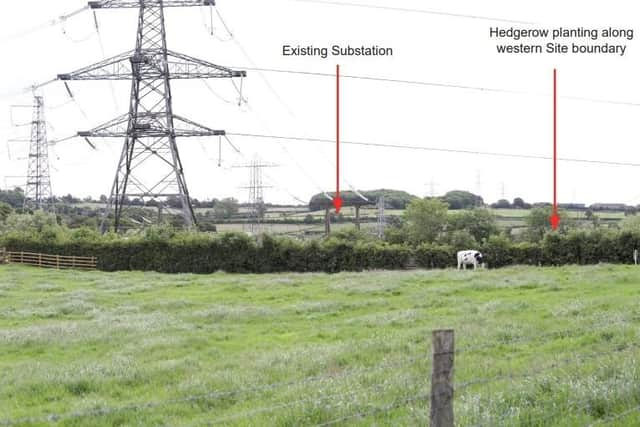

The proposed 15 metre tall substation is planned to be part of the wider National Grid’s Chesterfield to Willington pylon scheme involving the proposed roll-out of around 60km of 50metre high electricity pylons across Derbyshire’s countryside in a bid to meet the growing demand for cleaner and cheaper carbon energy.
National Grid’s proposed 14.5 hectare development site already includes the existing 275kV National Grid Chesterfield Substation off Calow Lane and it will form part of wider strategic upgrades to the national electricity transmission network, according to the council, but it is not regarded as a nationally significant infrastructure project.
But Mr Fullwood claims North East Derbyshire has already had to absorb massive solar and battery energy storage developments and he feels the latest plans sit in a high flood risk area on ground that has high levels of chemicals and former coal mining hazards while the plans also pose noise pollution and a threat to woodland and trees.
He argued the proposal presents a conflict with land protection policy and claims that HGVs will be moving down narrow lanes in the area after the developer has dismissed alternative sites due to economic considerations based on concerns for shareholders.
The proposal is contrary to planning policies which ordinarily restricts new developments in open countryside to preserve the character and landscape of the area, according to the council.
And NE Derbyshire District Council also acknowledged the plans will involve the felling of trees which are subject to a Tree Preservation Order, and that the site will affect the amenity of a neighbouring properties because the size of the existing substation will be increased heightening fears associated with electromagnetic fields and health implications.
Four residents raised objections with concerns about the loss of trees and hedgerows, the impact on wildlife, potential dust, noise and light pollution, construction traffic using narrow single lanes, levels of chemicals on the land, risks from former mining land, the relocation of footpaths, and the combined impact of new pylons, solar farms, and battery storage schemes in the area.
The Campaign to Protect Rural England also submitted concerns about the cumulative industrialisation of the countryside with energy schemes, and that the development will cause a visual intrusion and general disturbance with a loss of hedgerows, vegetation, productive agricultural land and tranquillity while reducing the value of the countryside.
But the district council said it has has received no objections to the plans from statutory consultees including Derbyshire County Council’s highways authority which stated any concerns could be addressed through planning conditions and a Construction Traffic Management Plan.
The county council’s infrastructure team has, however, highlighted that the site is within a Coal Development High Risk Area with previous surface mining having taken place on the land but the Coal Authority raised no objections to the plans.
Visual impacts from the substation are expected to be further reduced by appropriate landscaping and tree planting, according to the county council, and it stressed that any tree loss will have to be compensated by additional planting.
Derbyshire County Council’s flood team and Yorkshire Water also raised no objections subject to conditions including that any development be carried out in accordance with the drainage layout.
The Environment Agency raised no objections as did Chesterfield Borough Council subject to measures for proposed landscape design, mitigation and biodiversity net gain.
A council report stated that its officers consider the proposal will make a substantial contribution towards the provision of essential electricity infrastructure, energy security and the transition towards a lower carbon energy system.
However, the report also highlighted that officers conclude that the plans are expected to cause significant harm to the character, quality and perceptual qualities of the landscape and they represent a policy conflict with the North East Derbyshire Local Plan.
But the report added that council officers are satisfied that matters relating to residential amenity, noise, vibration, air quality, lighting, flood risk, drainage, contamination, land stability, ecology, archaeology, highway safety and public rights of way can be appropriately addressed through the proposed mitigation and the imposition of planning conditions.
However, Mr Fullwood’s mother Hilary Fullwood, of Hall Flash Farm, said: “I am surrounded by Great British energy. I have got solar panels at one side and all sorts of other things at the other side and now I am going to be confronted by this extremely large infrastructure.
“I am 82-years-old. I have lived in the property at Hall Flash Farm all my life and I do not want to see the land around it destroyed.”
Mrs Fullwood added that she is aware of the wider environmental problems but she argued that Calow is becoming very small and it is losing its rural landscape and that the site is ‘insecure’ and the area is vulnerable to flooding.
But the council’s report stated that even though Hall Flash Farm will experience views of the proposed development with a changed outlook, these matters do not give rise to unacceptable living conditions.
The council considered other potential impacts upon nearby Hall Flash Farm, Laurel House, Laurel Farm, Wrays Hill Farm and Nether House Farm but argued that restricted construction hours, controls relating to construction traffic, dust, noise and vibration means the proposal will not give rise to significant adverse effects on residential amenity.
A council report stated council officers are satisfied that matters relating to residential amenity, noise, vibration, air quality, lighting, flood risk, drainage, contamination, land stability, ecology, archaeology, highway safety and public rights of way can be appropriately addressed through the proposed mitigation and the imposition of planning conditions.
National Grid Project Director James Leeming told the meeting up to 12 different sites were considered around the Chesterfield region before the current site was selected.
He said new infrastructure is needed for the growing demand and need for electricity with better connectivity across the area and the development will sit on National Grid land alongside existing infrastructure and any impacts have been assessed and there will be mitigation.
Mr Leeming added that he hopes work can start at the site by the end of the year with a view to completing construction by the end of 2030.
Concerning Hall Flash Farm, Council Chairperson, Cllr Lee Hartshorne, said: “It’s going to have an effect on their life but we have also got to consider what’s before us and the impact this is going to have on upgrading the grid which is something we need to do.
“I would like to hopefully mitigate and do all we can and get the applicant to try and mitigate any issues that might occur and I am minded to go with the recommendation.”
Agent Charlie Mayer, for the applicant, recognised that the project is a departure from the council’s development plan because it involves open countryside but he pointed out that council officers agree that the benefits of the development outweigh the concerns.
A council spokesperson stated: ” Having considered all material planning considerations, officers conclude that the substantial public benefits of the scheme clearly outweigh the identified harm and development plan conflict.”
The council planning committee voted in favour of being minded to grant the development subject to conditions so the matter can be delegated to a council planning manager for a final decision expected in August due to the scheme’s departure from the council’s development plan.
Conditions include a Construction Environmental Management Plan, agreed construction times, a Site Waste Management Plan, a Habitat Management and Monitoring Plan, a Species Enhancement Plan, a lighting strategy, a Construction Traffic Management Plan, a Surface Water Drainage Strategy, and a Tree Protection Plan.
A spokesperson for National Grid said: "We understand proposals like this can be difficult for those living closest to them, but as Derbyshire uses more electricity, we need to strengthen the network so it can meet growing demand from nearby homes, businesses, hospitals and schools, while connecting cleaner, home-grown power from more affordable sources. If approved, we will continue to work with the local community to make sure the project delivers wider benefits for North East Derbyshire."