
Chesterfield council aims for ‘best outcome’ with ‘One Derbyshire, Two Councils’ proposal despite being compared to Guy Fawkes
Chesterfield Borough Council has voted in favour of its proposed ‘One Derbyshire, Two Councils’ option for the county with what it believes is a more balanced population split and with consideration for the possible boundary divisions faced by Amber Valley residents.
The Labour-controlled council held an Extraordinary Meeting on November 5 where it debated the Labour Government’s Local Government Reorganisation plans to set up single, unitary authorities across England with elected mayors in counties by replacing county, district and borough councils in two-tier authority areas like Derbyshire.
Derbyshire’s eight district and borough councils with Derby City Council have agreed their overall preference would be for north and south councils to replace the county’s current arrangement of ten councils but each have been setting out their personal preferences from a choice of four options under the ‘One Derbyshire, Two Councils’ format while Derbyshire County Council is now considering one single unitary council for the whole region.
Chesterfield Leader Tricia Gilby said: “Our final proposal for the reorganisation of Local Government within the Derbyshire county area – ‘One Derbyshire, Two Councils’ – is driven by a shared commitment to achieve the best outcomes for Derbyshire’s communities and to create a place where we all feel proud to work, live, belong and thrive.
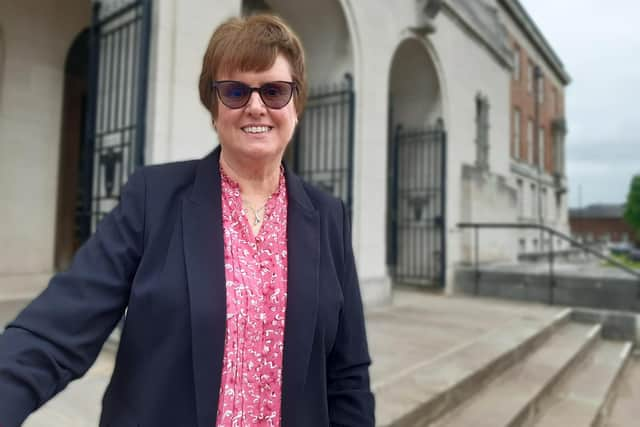

“It is a proposal that aims to recognise and protect Derbyshire’s distinct cultural, geographic and economic identities by developing two new partner unitary councils that are big enough to be financially resilient and deliver at scale, yet close enough to understand and respond to local needs.
“The two partner unitary councils will also be of a scale to provide effective political representation and attract the very best public sector leaders with the competence and capability to lead the authorities.”
Chesterfield Borough Council voted for Option B1 as its preferred recommended proposal out of a possible four considered options.
Option B1 would create a northern population of 539,000 over 2,012sq km and a southern population of 538,000 over 617sq km and see part of Amber Valley in the northern council and part of Amber Valley in the southern council with Amber Valley parishes split with some in the north and some in the south.
It would see Chesterfield, North East Derbyshire, Bolsover, Derbyshire Dales, High Peak, and part of Amber Valley in the northern unitary council, and Derby City, Erewash, South Derbyshire, and part of Amber Valley in the southern unitary council.
Parishes in the northern council would include: Aldercar and Langley Mill; Alderwasley; Alfreton; Ashleyhay; Codnor; Crich; Dethick; Lea and Holloway; Hazelwood; Heanor and Loscoe; Idridgehay and Alton; Ironville; Mapperley; Pentrich; Ravensdale Park; Ripley; Shottle and Postern; Somercotes; South Wingfield; Swanwick; Turnditch; Weston Underwood; And Windley.
Parishes in the southern council would include: Belper; Denby; Duffield; Holbrook; Horsley; Horsley Woodhouse; Kedleston; Kilburn; Kirk Langley; Mackworth; Quarndon; Shipley; And Smalley.
Cllr Gilby argued that consideration was given to Derby to allow it to grow in all directions and that by shifting the boundary of the southern Derbyshire unitary council further north to cover more of the parishes of Amber Valley delivers a near perfect balance of populations between the north and south councils.
She claimed that B1 also offers the best balance for the potential council tax base and a greater parity regarding the potential value each unitary council may generate with the northern council at £12,632m and the southern council at £14,235m.
Cllr Gilby also claimed that Option B better reflects the interests of residents in the south of Amber Valley who travel into Derby allowing them more say over the city and its services while supporting its costs with council tax payments.
She added that residents in the north of Amber Valley who have a stronger affinity with the Derbyshire Dales, NE Derbyshire and Bolsover would better benefit by being part of the northern council.
Cllr Gilby also said that Option B1 gives the best balance in terms of population size and political representation with 83 councillors in the north and 79 in the south.
The council based its choice on the ‘main cost drivers’ that influence council expenditures including the number of residents aged over 65, the percentage of children in low-income families, homelessness rates and anticipated rates of population growth while the council feels Option B offers a greater balance in terms of demand pressures on the proposed north and south councils.
The dismissed alternatives included Option A1 which would see a northern population of 567,000 and a southern population of 511,000 and a different breakdown of parts of the Amber Valley in the northern and southern unitary councils.
Other options under consideration by other councils include Option A which would see Amber Valley in the northern council with a northern population of 584,000, and the southern council area would have a population of 494,000.
Option B would place Amber Valley in the southern council and would see a northern population of 456,000, and the southern council area would have a population of 622,000.
Cllr Gilby stressed that irrespective of the options, the proposed ‘One Derbyshire, Two Councils’ forecasts accumulative savings of up to £167m by the sixth year, and despite estimated savings of just £4.4m in its first year these are expected to rise to £44m per annum in its sixth year.
The council also explained that to implement reorganisation a one-off investment of £65.4m will be needed and the expected payback on this payout would be around three-and-a-half years and it is estimated that by March, 2028, there will be £90m of available reserves to fund this cost.
The city, borough and district councils have argued that one unitary authority for Derbyshire will not work because of the size of the county but a system with a north council and a south council will maintain the historic areas of the county and provide better opportunities to work in partnerships especially with the East Midlands Combined County Authority.
They have also argued one, single unitary authority would create an inefficient delivery of services, would stifle economic and housing growth and create a disparity between Derbyshire and Derby in terms of population and tax base.
The city, borough and district council leaders claim two new unitary councils will keep the councils connected to local residents and their needs, provide effective and value for money services, preserve local identity and protect Derbyshire’s historic boundaries and meet the Government’s criteria for reorganisation.
They also argue the two new unitary councils will provide high quality and sustainable services, work together to understand and meet local needs, create opportunities for stronger community engagement and neighbourhood empowerment, improve efficiency, capacity and financial resilience and support devolution.
The Government has argued LGR plans will include elected mayors with more powers on planning and transport and that the changes will create savings, create greater efficiency, improve public services, and support economic growth.
But critics are concerned about the loss of councils – with Derbyshire reduced from 447 councillors to 162 – the loss of local control with a risk of greater Government influence, the removal of local decision-making, tax increases, powers being taken away from communities and some also doubt the plans will create savings.
Opposition Liberal Democrat Chesterfield Borough Cllr Paul Holmes has opposed the concept of imposing unitary authorities which he dubbed as ‘Hobson’s Choice’ with no democratic mandate with the ‘obliteration’ of up to 200 councils while saying it does not represent the best interests of Chesterfield residents.
During the council meeting, on bonfire night, Cllr Holmes drew comparisons with Guy Fawkes’ bid to bring down Parliament alongside Chesterfield Borough Council’s vote to bring an end to the borough council.
He said: “You want to replace that by merging Chesterfield into a huge remote and out of touch council of over 500,000 people or more, stretching all the way to the other side of Derbyshire.
“You want to force diverse and widely spread geographic communities into a single, massive, one size fits all mega council. Large unitary councils like that make sense in compact urban communities such as Sheffield or Derby. They do not make sense in thinly spread and diverse communities across mainly rural counties.”
Cllr Holmes also raised concerns about plans to cut the number of councils and councillors in England, despite claiming England already has far fewer democratically elected representatives and councils per head of population than any equivalent European democracy or the USA or Canada.
He claimed the borough council is following instructions from the Labour Government despite his claims that research has found no evidence of savings with LGR and after it has not been subject to any Government independent cost analysis.
Cllr Holmes also questioned whether larger councils are more financially stable citing examples such as Birmingham, Nottingham and Bradford who have had to issue bankruptcy notices.
He also argued that moving money and decision-taking upwards from local councils is not devolution.
Cllr Holmes told the council: “It is an absolute travesty to pretend that you are putting community first. Creating large, remote organisations to administer Government policy do not do that.
“Reducing existing councils to zombies for the next two-and-a-half years benefits no one. Diverting £65m and huge amounts of officers’ time to doing this is absolute folly at a time when council budgets are already stretched to the limit.”
He claims that residents will begin to notice when money is diverted from districts and boroughs into the massive funding gap of adult and children’s care and special educational needs.
Cllr Holmes claims residents will also notice the number of councillors has been reduced and that the majority will be elected from outside residents’ areas and they will also notice when the borough’s assets and play areas start to get ‘financially squeezed’.
But Labour Cllr Jenny Flood argued the borough council is currently ‘powerless’ to help those that need the most support under the current two-tier structure.
She said: “The county council is not delivering for the people of Chesterfield. We have more deprivation than we had in 1974 in our time.
“We have children in abject poverty and I am appalled that 69per cent of our children in the area I cover are actually worse off now than were their families in 1974.
“And that’s appalling because we have been working so hard with separate community groups to try and help them but that is not happening because the county council controls the finances.”
Cllr Flood argued that reorganisation will make sure the area is not consumed with more and more deprivation and it will provide an opportunity to put services back at a grass roots level and develop transport links for travel and work.
Labour Cllr Amanda Serjeant argued that LGR will rid borough councillors of the inability to act upon requests concerning matters currently outside of their remit such as with social care and special educational needs and that residents are less concerned about the number of councillors and more concerned about service delivery.
She said: “There are proposals that deliver financially stable councils and they will deliver these savings in three-and-a-half years. There will be huge savings delivered to many that can be put into more efficient service delivery and I think that is what people want.”
Cllr Gilby told the meeting: “All the evidence shows that Chesterfield is better off adopting [option] Base B modified to B1 and that is what the recommendation before you tonight is and what you are being asked to vote on.”
Councillors voted by a majority to recommend the ‘One Derbyshire, Two Councils’ Option B1 as their preferred proposal – despite opposition from all the present Liberal Democrat councillors – and this option will be presented to the council’s Cabinet on November 11 to endorse the proposal before it is submitted to the Government for consideration.
Other district and borough councils, together with Derby City Council, are all also proposing to reduce the number of local authorities covering Derbyshire from 10 to two and they are also deciding on their preferred otions this week before a November 28 deadline to submit all proposals to the Government for consideration.
Following a Bolsover District Council meeting and an Executive meeting, on November 5, the authority has established its proposed option is A1 which would have different parishes from Amber Valley joining each of the north and south councils and would give a northern population of 567,000 across 2,068sq km and a southern population of 511,000 across 560sq km.
NE Derbyshire District Council also voted by a majority on November 3 for Option A1 and this will be presented to its Cabinet on November 6, to be rubber stamped before being submitted to the Government.
Derbyshire County Councillors will be asked to consider proposing one single unitary council for the whole of Derby and Derbyshire as the authority’s preferred option for LGR at a Full Council meeting on November 13.
The Government will review all council proposals before making a final decision on how Local Government is best reorganised in Derbyshire in the summer of 2026.
Under the Government’s current timetable, elections to the new shadow authorities would take place in 2027, and the new unitary councils would start to operate by April 2028.
Derbyshire’s eight district and borough councils include: Amber Valley Borough Council; Bolsover District Council; Chesterfield Borough Council; Derbyshire Dales District Council; Erewash Borough Council; High Peak Borough Council; North East Derbyshire District Council; and South Derbyshire District Council.