
Own a piece of military and cinematic history as the binoculars of Sir Barnes Wallace - inventor of the Dambusters' bouncing bomb - go to auction
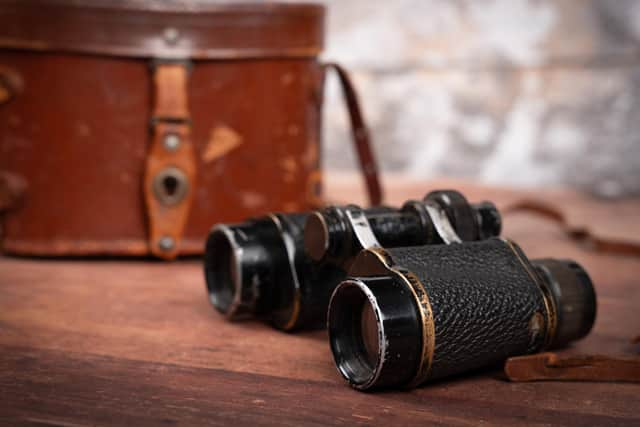
Binoculars that Sir Barnes Wallis used in 1943 when he was leading experiments to design the bouncing bomb, which was instrumental in the success of the Dambusters’ wartime raid on Germany, are going up for auction.
The pair of binoculars are particularly special because Sir Barnes Wallis eventually gave them to Sir Michael Redgrave to use in the making of the 1955 film The Dam Busters, part of which was filmed in Derbyshire. Members of the RAF’s 617 Squadron – nicknamed the Dambusters – practised their low-level bombing techniques at Ladybower and Derwent Reservoirs in the Peak District.
A plaque on the binoculars is engraved with “Michael Redgrave CBE – From Barnes Wallis CBE – I Used These At Reculver In 1943,” referring to the location in Kent where Sir Barnes Wallis used these binoculars - including experiments for the famous Bouncing Bomb of which he was mastermind.
In very fine condition, the binoculars are estimated to sell for £9,000 to £10,000 as part of a militaria auction at sgbaldwins.com on February 12, 2026.

Barnes Neville Wallace was born in Ripley, Derbyshire, in 1887. His first job was in marine engineering and in 1913 he moved to Vickers where he designed airships. In 1930, Wallis transferred to working on aircraft where his achievements included the first use of geodesic design in engineering, which was used in his development of the Wellesley and Wellington bombers. When the Second World War began in 1939, Wallis was assistant chief designer at Vickers' aviation section.
In February 1943, Wallis revealed his idea for air attacks on dams in Germany. He had developed a drum-shaped, rotating bomb that would bounce over the water, roll down the dam's wall and explode at its base. The bomb was codenamed 'Upkeep'. Impressed with the concept, the chief of the air staff, ordered Wallis to prepare the bombs for an attack on three dams in the important German industrial region of the Ruhr. The legendary Dam Busters raid, officially known as Operation Chastise, took place on the night of May 16/17, 1943. It saw nineteen Lancaster bombers from RAF Scampton take off on a mission to destroy the Möhne, Edersee and Sorpe dams in Germany's Ruhr Valley.
A crucial part of the success of this mission was Sir Barnes Wallis's bouncing bomb, designed to skip over a series of torpedo nets so it could reach and destroy its target. Sir Barnes himself referenced these tests in a 1951 speech, describing how at first he experimented in his back garden, using a small catapult to fire marbles at the surface of water to determine the physics needed to make a bomb bounce.