
"He was painting heaven upon earth": WW2 soldier's long lost artistic gift to Derbyshire community rediscovered

A huge mural painted on the wall of Bakewell Town Hall by a Second World War soldier grateful for the town’s hospitality has been partially uncovered and commemorated some 70 years after the council decided to obliterate it during redecoration.
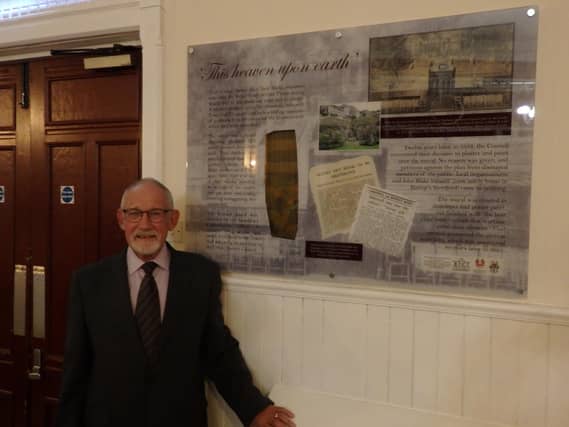
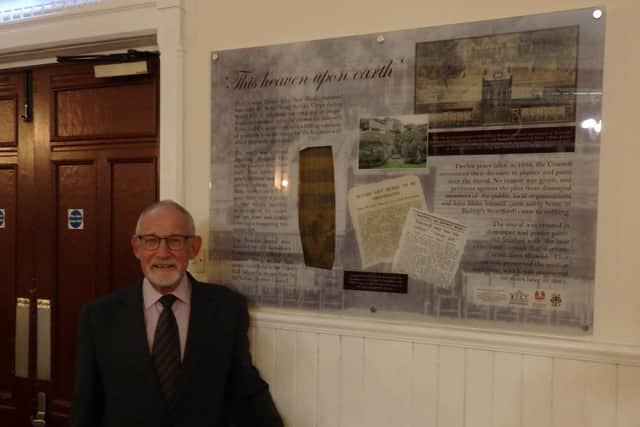
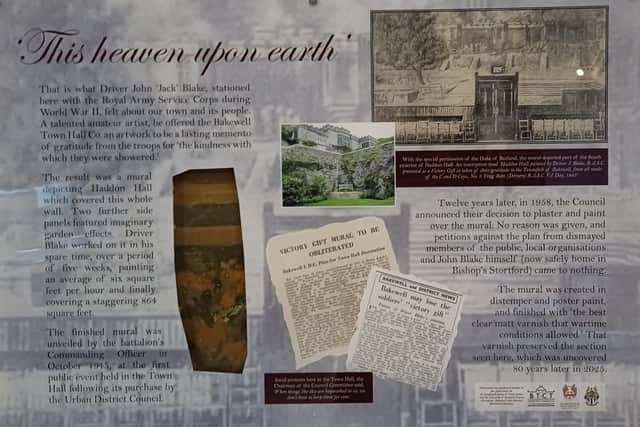
A new interpretation panel was recently unveiled in the assembly room telling the story of the artwork and artist and offering a window to a small corner of the painting which has been covered by layers of paint and wallpaper over the years.
The 864 square-foot mural, which depicts the south face of nearby Haddon Hall, was dedicated to the Townsfolk of Bakewell on Victory over Japan Day, August 15, 1945, as a departing gift from Private John Blake, a driver stationed at local training facilities with the Royal Army Service Corps (RASC).
Its existence was bought to light by Darley Bridge resident Stephen Coates, president of the Bakewell & District Historical Society, following a chance discovery in 2019.
He said: “I was chair of trustees at the Old House Museum, and there looking through a filing cabinet filled with an assortment of documents about Bakewell, among them was a little wallet containing a very poor quality newspaper photograph from the Derbyshire Times – now thought to be the only pictorial record of the mural – and other newspaper cuttings on the controversy when it was covered up.
“As a former volunteer guide at Haddon I knew the scene and I knew this wall, so I was curious to know how these two buildings came to be combined. It seemed like an interesting story.”
Stephen’s initial research was published for posterity in the society’s annual journal in 2022, at which point he assumed the story was over.
He said: “I made a lot of enquiries but nobody really knew about this. It was obliterated in 1958 so there were few people left who were aware it was there in the first place. I did find one person who remembered it from dances at the hall when she was a teenager.

“I was a pupil at Lady Manners School at the time of the controversy but entirely unaware of the story.”
He added: “The mural represented part of our local history that was ignored, indeed literally painted out, at the behest of the authorities that ought to have been working on our behalf to preserve local history but on this occasion certainly did not seem to do so.
“Then in 2024 Marie Wildgoose was appointed as manager of the Town Hall Trust and she was just as curious as me. We spurred each other on and began contacting organisations in Bishop’s Stortford, where we knew the artist had come from.”
Born in Plymouth in 1902, Blake lived the majority of his life in Hertfordshire, and began painting at the age of seven.
Known to some as Jack, in early adulthood he found work as a footman to the Lyle family – of Tate & Lyle sugar riches – then moved on to another wealthy household which soon fell on hard times, leaving him homeless and destitute with his housekeeper wife Hilda and their young son.
For a while, they made ends meet by selling the homemade Blake’s Cakes from a handcart, but suffered further misfortune when part of their home collapsed in a thunderstorm.
All the while John continued to paint, becoming a founding member of the Bishop's Stortford Arts Society in 1935.
Between 1941 and 1945 he enlisted in the RASC and came to work in the camps at Haddon House Farm and what is now Burton Closes Hall Care Home, where men of fighting age prepared for deployment.
Stephen said: “Thousands of troops spent time in the town during this period. In the town, they were well-received, well-behaved and well-integrated with locals.
“We don’t know precisely how long Driver Blake was here but as one of the final contingent at the end of the war he asked that he might be allowed to paint a mural as a token of gratitude to the people of Bakewell – a sort of memorial to those who served but were not known to have died.”
The proposal was approved by the authorities of the time and the tenth Duke of Rutland, and the painting took Blake 146 hours to complete over five weeks, fitted in around his army duties.
He used distemper and poster paints, as the only options available in the wartime economy, and finished off with a preserving coat of clear varnish which would be crucial to protecting the mural through later phases of building alterations.
Stephen said: “The presentation and unveiling ceremony was the first public function to take place in the town hall following its purchase by Bakewell Urban District Council on October 1945. Many supporters and onlookers were said to be present.
“Driver Blake told those assembled that since he had come to Bakewell and seen Haddon Hall, he had conceived the idea of painting that ‘heaven upon earth.’
“Accepting the gift, council vice-chairman Mr Brooke-Taylor said they appreciated what Driver Blake had done and it would always be a joy to them to look at that
painting.”
But 13 years later, a new administration was in power locally, and gazed up at the wall with less joyful tastes.
Stephen said: “In January or February 1958, the council decided, apparently without consulting the public or local organisations, to obliterate the mural.
“Mr RA Harvey, chairman of the committee, was reported to have said, ‘When things like this are bequeathed to us, we don’t have to keep them forever.’”
When it became public knowledge, the outcry made headlines across Derbyshire, Sheffield and back in Bishop’s Stortford, but representations put forward by the Bakewell Historical Society, the Royal British Legion and Blake himself fell on deaf ears.
Stephen said: “I thought it was bit of a Trump-ist decision, and something of an insult. This was a gift to say thank you. You would never dream of destroying a war memorial to those who died.
“The way it was done was dictatorial, unilateral and ought not to have happened.”
Although Stephen and his co-investigators learned of that past, they had no way of knowing what was left of it today until one of them took matters into his own hands.
Stephen said: “A member of the Town Hall Trust, Mike Horrod, decided to bite the bullet and scratch away a little section with a steamer and a wallpaper scraper. The area was no bigger than an A3 piece of paper, but it revealed a flight of steps from the Haddon gardens – sure enough the mural existed.
“I felt a sense of redemption in that moment – like it wasn’t all a myth. It was exciting to see and made it all worthwhile.”
Though conversations continue about potentially uncovering more of the mural, for now the visible fragment has been framed for display with a panel created by local company Archaeological Research Services and paid for by Jo and Tony Longland-James, members of the Town Hall Trust and Historical Society.
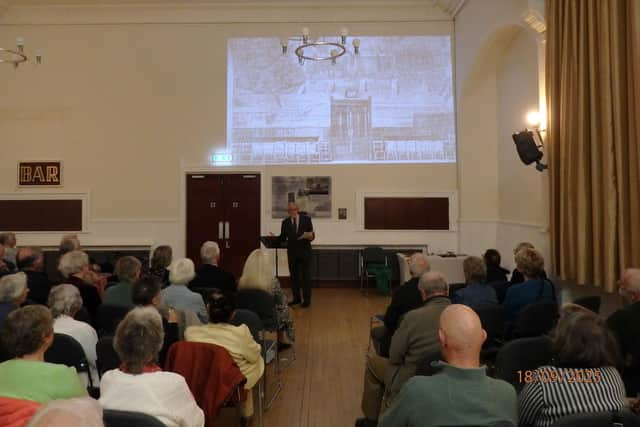
Their efforts were celebrated at a ceremony attended by hundreds of today’s townsfolk last month, shown alongside newly embroidered decorative panels created by members of Bakewell U3A .
Stephen said: “I’d like to think it’s pretty well all there but it’s possible the bit we chose to reveal is not representative. A serving hatch was punched through the wall at a later stage, so that part of it is definitely gone.
“It would probably look overpowering now as the picture was quite dark, and some of it may not be in as good a condition.”
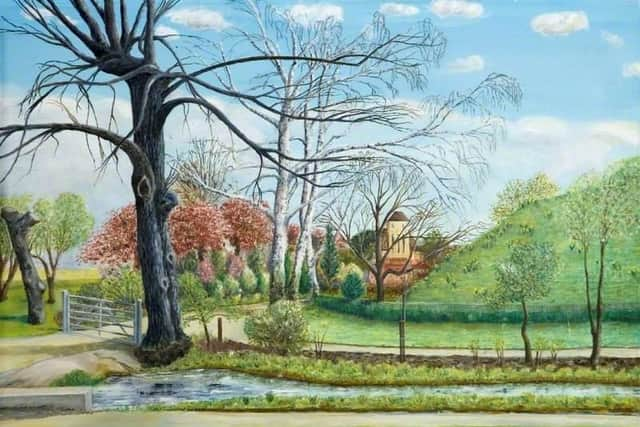
While Bakewell’s mural may remain otherwise hidden, the research involved has turned up more instances of Blake’s work back in his hometown, where he managed a cinema after the war, volunteered in the local hospital and church, and died in 1985.
Blake’s paintings earned local renown and came to be regarded as a vital record showing how the town’s buildings and landscaped evolved over the mid-20th century, including many scenes that have since disappeared.
His son, John junior, took after his father’s interest by becoming an architect, and is also now deceased.
Stephen said: “A large number of his works were hung in the British Legion Club in Bishop’s Stortford, mostly landscapes and architectural subjects, and they have since been transferred to the local rugby club. We’re going down there soon to have a look at those.
“The British Legion closed down and the premises were converted to residential use in the last five years. When the tradesmen were there doing the work they found several more Blake murals on the walls.
“Thankfully they had the foresight to take a few pictures of them, but sadly the current owners of the property decided they weren’t interested and painted over them again.”
He added: “I’m just delighted to have brought the Bakewell mural out into the open again, and to know a lot more about the very humble man who created it in the first place.
“He had a hard life, nothing came easy to him, and I think his contribution to Bakewell’s history ought to be remembered.”